The National Economics University (NEU) and the University of Applied Sciences Koblenz collaborate to implement the International Transfer Program for the Bachelor of Arts in Sustainable Transformation Management.
11/07/2026 2026-10-20 10:25The National Economics University (NEU) and the University of Applied Sciences Koblenz collaborate to implement the International Transfer Program for the Bachelor of Arts in Sustainable Transformation Management.
The National Economics University (NEU) and the University of Applied Sciences Koblenz collaborate to implement the International Transfer Program for the Bachelor of Arts in Sustainable Transformation Management.
In the context of green transition, sustainable development, and innovation becoming key drivers of global growth, the demand for human resources with interdisciplinary thinking and the ability to lead transformation processes is increasing. To meet this trend, the National Economics University (NEU) and the University of Applied Sciences Koblenz (UASK), Federal Republic of Germany, have collaborated to implement the International Transfer Program for the Bachelor of Arts in Sustainable Transformation Management. This program opens opportunities for NEU students to study under a 2+2 model in Germany, while accessing an interdisciplinary field of study that is increasingly attracting the attention of universities, businesses, and international organizations.
On June 29, 2026, the National Economics University and the University of Applied Sciences Koblenz completed the signing of the Cooperation Agreement regarding the Articulation Programme “Sustainable Transformation Management – Bachelor of Arts.”
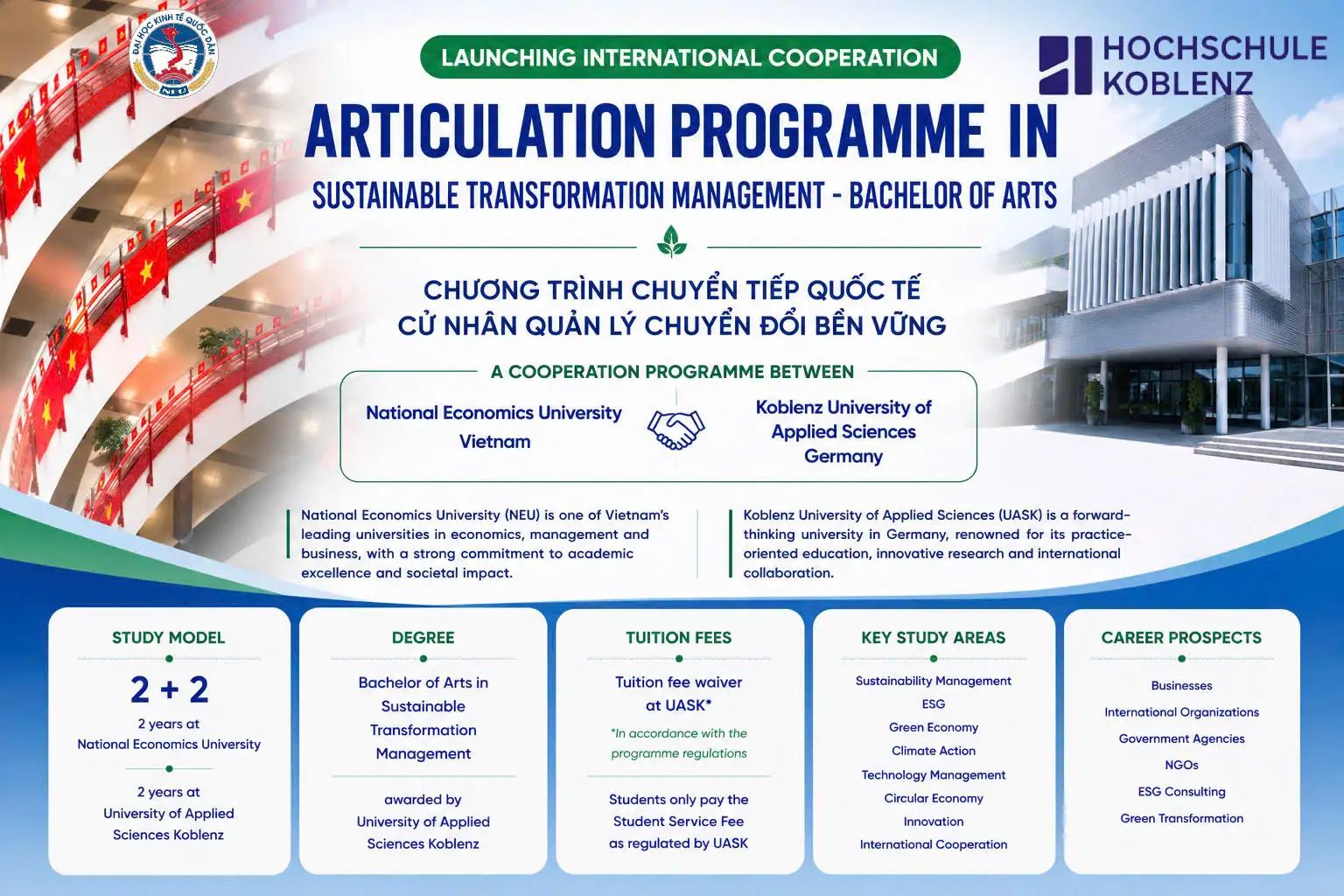
The National Economics University and the University of Applied Sciences Koblenz collaborate to implement the International Transfer Program for the Bachelor of Arts in Sustainable Transformation Management
The agreement introduces a new international transfer program for NEU students, reflecting the University’s direction in developing interdisciplinary academic programs, expanding collaboration with prestigious academic partners worldwide, and training human resources to meet the demands of the green economy and sustainable development.
Training Human Resources for the Green Economy
Green transition, sustainable development, digital transformation, and innovation are profoundly changing the development strategies of nations, businesses, and organizations globally. This places new demands on higher education to train human resources with interdisciplinary thinking, innovative capacity, and the ability to solve complex issues of the modern economy and society.
As one of Vietnam’s leading universities in economics, management, and business administration, the National Economics University is gradually expanding its academic programs in an interdisciplinary direction to meet the demands of the digital economy, green transition, and sustainable development. Among these, the Bachelor of Environmental Technology and Sustainability program is designed to train human resources with a foundation in technology, economics, and management to address environmental and sustainable development challenges from an interdisciplinary perspective.
The collaboration with the University of Applied Sciences Koblenz is the next step in this direction, creating opportunities for students to access Germany’s advanced educational model while expanding academic learning and exchange opportunities in an international environment.
On the partner side, the University of Applied Sciences Koblenz is a public university of applied sciences in Germany, renowned for its educational model that closely integrates academia and practice. The university places particular emphasis on education for sustainable development, encouraging interdisciplinary thinking and developing innovative solutions to address economic, social, technological, and environmental challenges. The alignment in development direction and educational philosophy forms the foundation for the two universities to collaborate on this program.
International 2+2 Educational Model
According to the agreement, students will complete the first two years at the National Economics University under the Bachelor of Environmental Technology and Sustainability Program, before transferring to the University of Applied Sciences Koblenz to study the final two years of the Bachelor of Arts in Sustainable Transformation Management.
The courses accumulated at the National Economics University (NEU) will be recognized by UASK based on the credit conversion table jointly developed by the two universities. Both parties will also collaborate in managing the program, reviewing the curriculum, and ensuring academic quality to facilitate students’ transition process.
The highlight of the program is its interdisciplinary approach, combining knowledge of economics, management, social sciences, and technology management to train a workforce capable of managing transformation processes towards sustainable development.
The program not only focuses on environmental issues but also equips learners with knowledge and skills in areas such as sustainable development management and ESG, environmental management, climate protection, digital transformation, technology management, innovation, circular economy, social entrepreneurship, and international collaboration. These are all fields prioritized by many businesses, international organizations, and regulatory agencies to realize sustainable development goals and build a green economy.
Study in Germany, Develop Global Competence
Through the transfer program, NEU students will have the opportunity to study in Germany’s applied higher education environment, access practical training methods, and experience an international academic environment with students from various countries.
Upon completing all academic requirements of the program, students will be awarded a Bachelor of Arts in Sustainable Transformation Management by the Koblenz University of Applied Sciences, in accordance with university regulations.
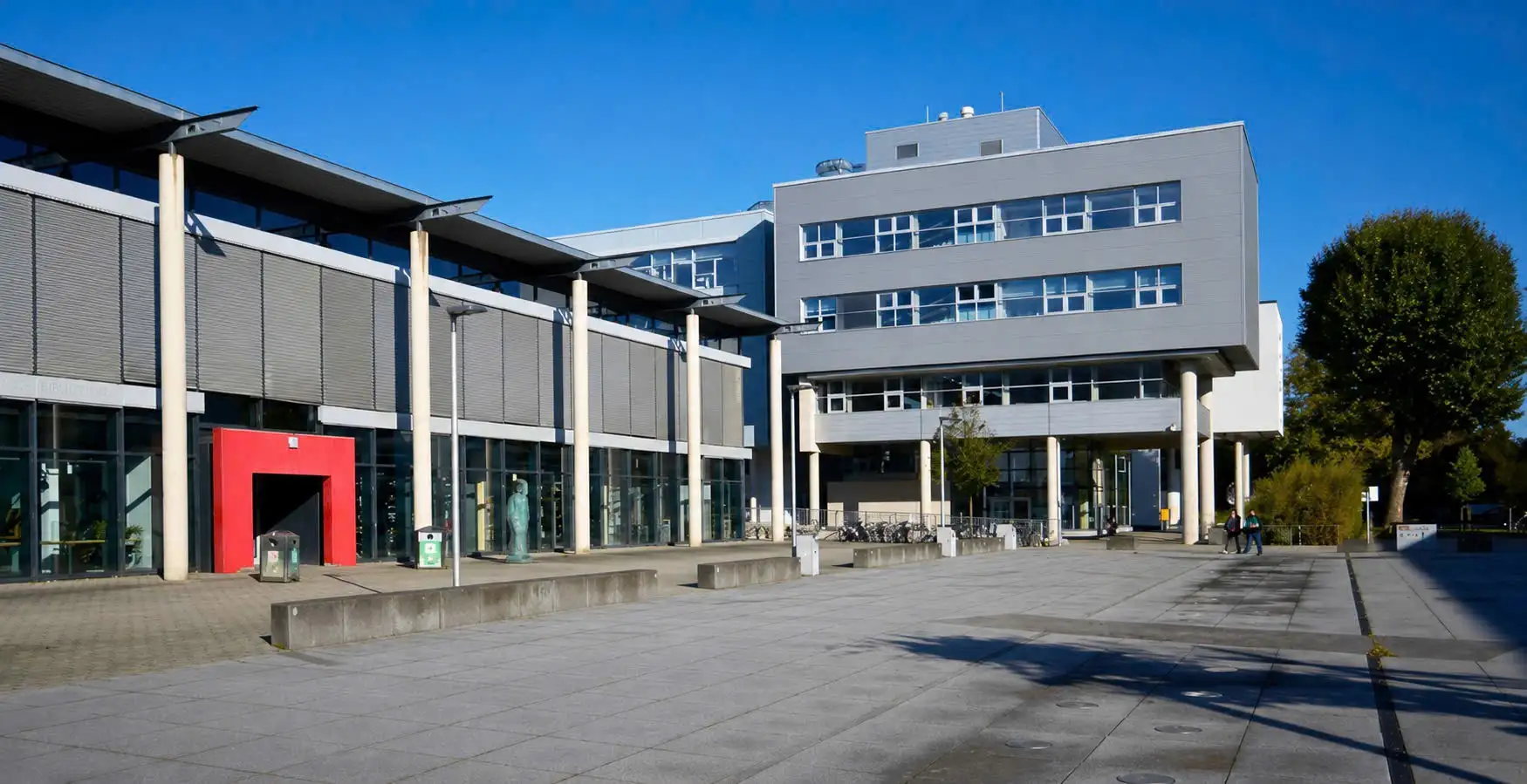
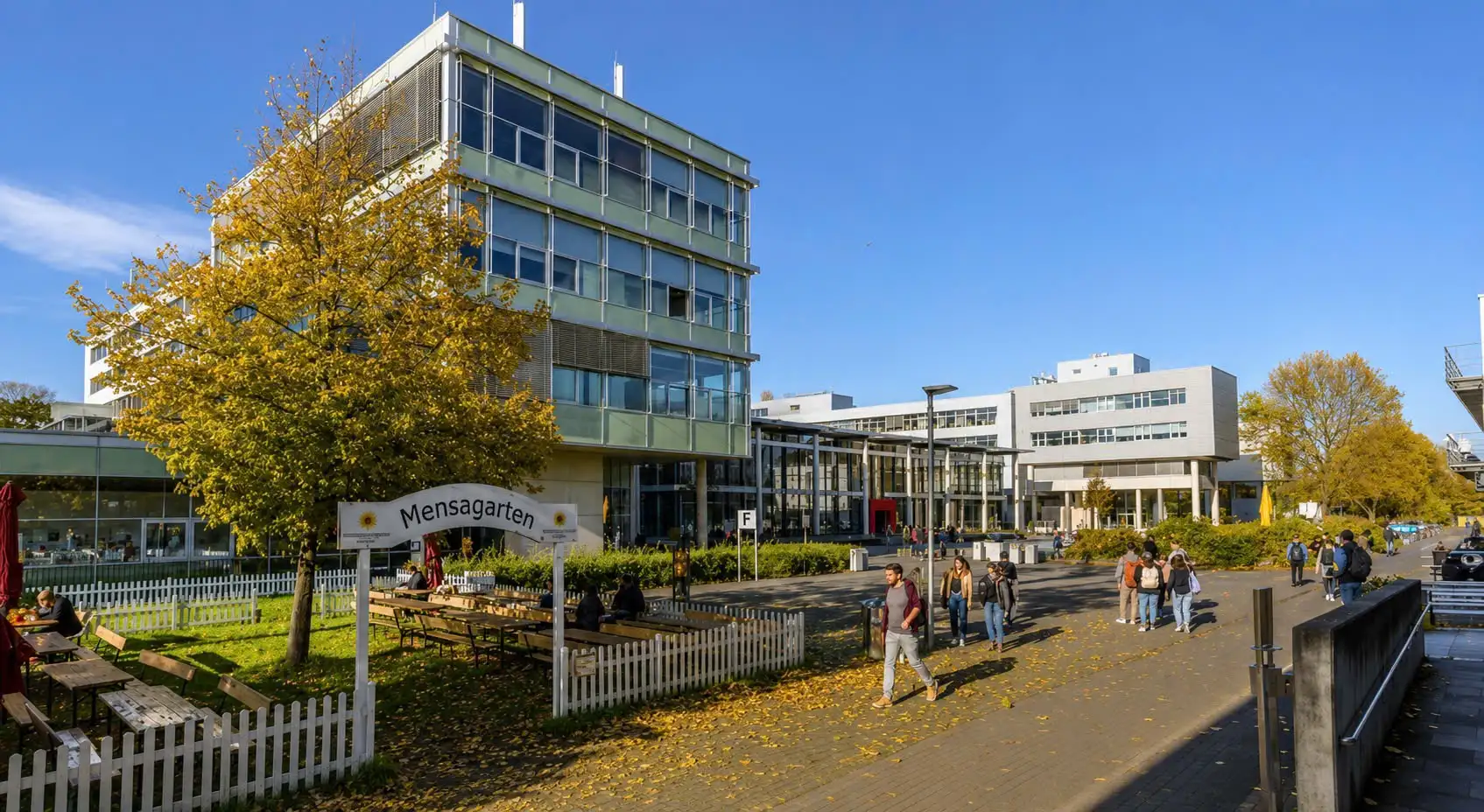
Campus at Koblenz University of Applied Sciences (Germany)
One of the outstanding advantages of the program is that students studying at UASK are exempt from tuition fees as per the program’s regulations and only pay student service fees according to the current university regulations. This facilitates students’ access to high-quality German higher education at a reasonable cost.
In addition to specialized knowledge, the program helps students develop language proficiency, interdisciplinary thinking, skills to work in multicultural environments, and the ability to adapt to global professional contexts. These competencies are increasingly valued by businesses, international organizations, and regulatory agencies in promoting green transformation, innovation, and sustainable development.
With the knowledge and skills acquired, graduates can pursue careers in businesses, government agencies, international organizations, development organizations, or projects in fields such as sustainable development, ESG, environmental management, green transformation, technology management, and innovation.
Towards Long-term Academic Collaboration
The collaboration in implementing the International Transfer Program for the Bachelor of Arts in Sustainable Transformation Management not only expands international study opportunities for students but also lays the foundation for NEU and Koblenz University of Applied Sciences to further develop cooperation in training, research, and academic exchange.
Based on the current curriculum, the two universities are continuing discussions to develop a Dual Degree Programme model in the future. Under this direction, students who fully meet the academic requirements of both universities will have the opportunity to receive degrees from each institution according to current regulations.
According to the direction being developed by both parties, NEU students can simultaneously receive a Bachelor of Arts in Sustainable Transformation Management from UASK and a Bachelor of Environmental Technology and Sustainability from the National Economics University if they meet all graduation requirements of each university. Concurrently, UASK students will also have the opportunity to study part of the program at NEU through a credit recognition and transfer mechanism. These contents are currently under discussion and development between the two parties.
In addition to education, the two universities also aim to expand collaboration in academic research, faculty and student exchanges, and the development of joint academic initiatives in the fields of sustainable development, management, and innovation.
A Step Forward in the Internationalization Strategy of the National Economics University
The collaboration in implementing the International Transfer Programme in Bachelor of Arts in Sustainable Transformation Management continues to expand the international academic partnership network of the National Economics University. It also reflects the University’s orientation in developing high-quality academic programs, enhancing the internationalization of the curriculum, and providing numerous learning and research opportunities in a global environment for students.
More importantly, the program reflects the University’s orientation in aligning education with global development trends, particularly in green transformation, sustainable development, and innovation. Through collaboration with prestigious international partners, NEU continues to expand the space for learning, research, and academic exchange, while also enhancing the quality of education to international standards.
The collaboration between the National Economics University and the University of Applied Sciences Koblenz also contributes to strengthening higher education connections between Vietnam and Germany, laying the foundation for the two universities to continue developing in-depth collaborative programs in the future.
Not only does it provide NEU students with an international study pathway, the International Transfer Programme in Bachelor of Arts in Sustainable Transformation Management also contributes to training a generation of workforce with global thinking, interdisciplinary capabilities, and the ability to lead transformation processes towards a green economy, innovation, and sustainable development. These are also the core competencies that countries, businesses, and organizations worldwide are seeking to address future development challenges.
Article and Photos: International Collaboration Department & Communications Department