Seminar “Designing Mixed Methods Research: Integrating Qualitative and Quantitative Research”
12/08/2026 2026-10-20 10:13Seminar “Designing Mixed Methods Research: Integrating Qualitative and Quantitative Research”
Seminar “Designing Mixed Methods Research: Integrating Qualitative and Quantitative Research”
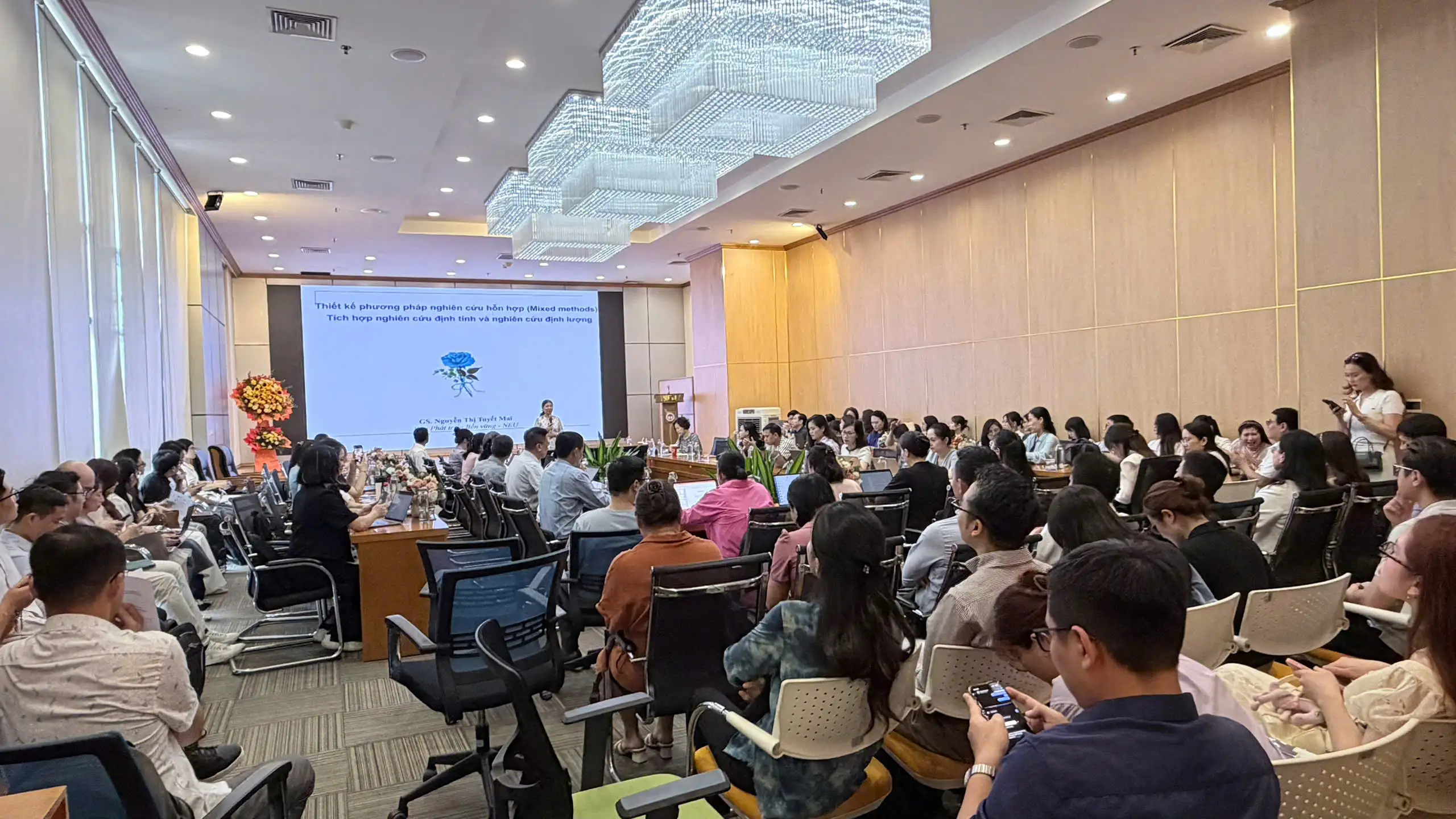
To enhance academic exchange, share experiences, and improve research capabilities for faculty members, scientists, and doctoral candidates, the National Economics University is organizing a seminar on the topic “Designing Mixed Methods Research: Integrating Qualitative and Quantitative Research,” featuring a presentation by Prof. Dr. Nguyen Thi Tuyet Mai from the Institute for Sustainable Development, National Economics University.
Program Overview
The seminar focuses on clarifying the approach, design, and application of Mixed Methods Research (MMR), which combines qualitative and quantitative research within a single study or research project. This method is increasingly widely used across various fields, allowing researchers to leverage the strengths of both approaches to address complex research issues.

Dr. Trinh Mai Van – Deputy Head of the Department of Scientific Management delivers the opening speech
Commencing the discussion, Prof. Dr. Nguyen Thi Tuyet Mai elucidated the foundational issues of research design. Accordingly, research design is viewed as a plan that determines how to conduct a study to answer research questions, achieve objectives, and fulfill specific goals. A research design must clearly identify data sources, data collection and analysis methods, ethical issues, and potential limitations during implementation.
Building on this foundation, the seminar delves into the formation and development of mixed methods research. Since the 1980s, Mixed Methods has been recognized as a distinct and systematic research method. The emergence of specialized monographs, journals, and the International Association for Mixed Methods Research has subsequently contributed to the advancement and increasingly widespread application of this method in social and behavioral sciences.
According to the shared content, no research method is perfect; both qualitative and quantitative research have their own strengths and limitations. Therefore, combining the two methods can help the strengths of one approach complement the limitations of the other. Mixed methods research is particularly valuable when addressing complex issues, enhancing the reliability of results, developing measurement scales, or combining the richness of qualitative data contexts with the generalizability of quantitative data.
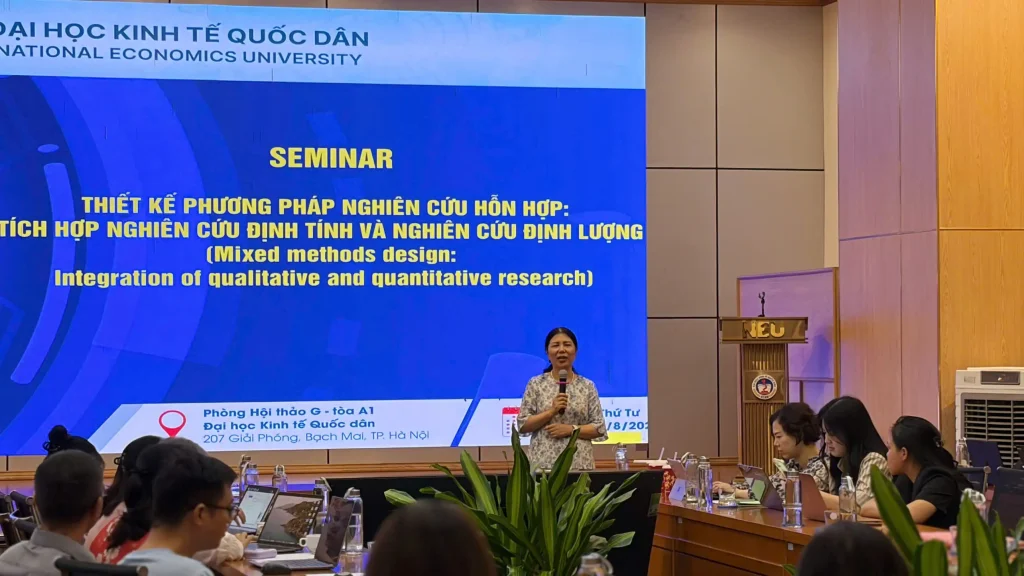
Main Speaker – Prof. Dr. Nguyen Thi Tuyet Mai – Institute for Sustainable Development, National Economics University
One of the key focuses of the Seminar is the selection and design of mixed-method research appropriate for each research question. Assoc. Prof. Dr. Nguyen Thi Tuyet Mai introduced three basic designs, including: sequential exploratory mixed design, starting with qualitative research followed by quantitative research; sequential explanatory mixed design, starting with quantitative research and continuing with qualitative research to further explain the results; and concurrent mixed design, where qualitative and quantitative research are conducted in parallel.
Theoretical content is illustrated through numerous practical studies, thereby clarifying how to combine in-depth interviews, group discussions with quantitative surveys in the process of problem exploration, scale development, hypothesis testing, and interpretation of research results. Notably, with the sequential explanatory design, quantitative data can be related to qualitative data and integrated when presenting results, providing researchers with additional basis to interpret the findings obtained.
The practical implementation in the E-PhD program also demonstrates that mixed-method research has been applied in many research fields of business and management. During the period 2021-2026, 11 out of 25 dissertations in the field of business and management were successfully defended using mixed-method research, focusing on areas such as entrepreneurship, human resource management and organizational behavior, marketing, and international business. Among these, the sequential exploratory mixed design is more commonly used.
Besides the advantages, the Seminar also highlights the requirements and challenges when applying mixed-method research. Researchers not only need to understand the nature of the method but also must have the skills to conduct both qualitative and quantitative research. More importantly, the ability to “integrate” the two components is crucial, ensuring that qualitative and quantitative data are connected and complement each other rather than existing as two separate research parts. The choice between sequential or concurrent design, and prioritizing qualitative or quantitative data, must also be clearly determined during the research design process.
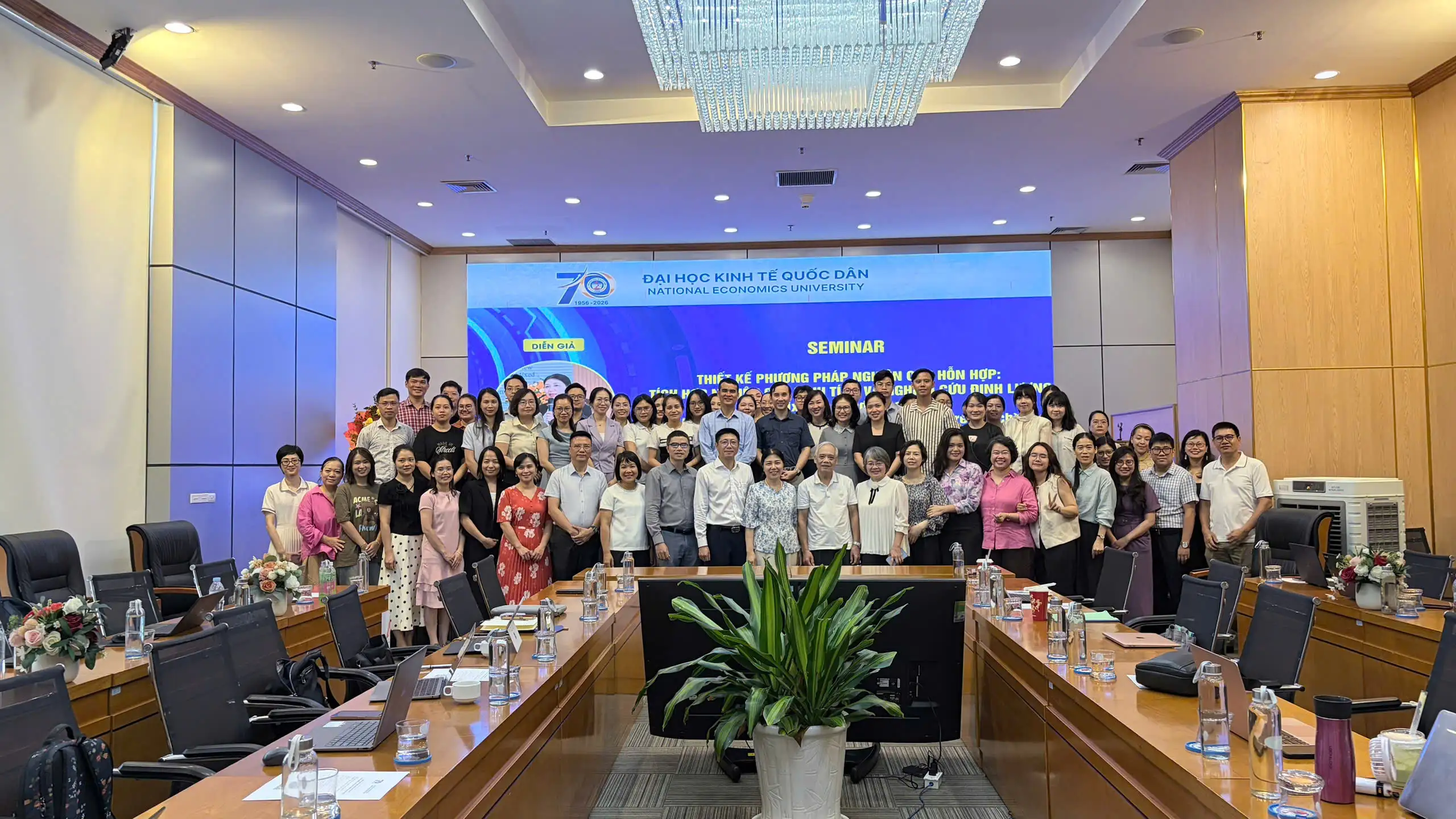
Participants of the program take a commemorative photo
Through in-depth analyses and specific research examples, the Seminar contributes to helping participants gain a more systematic view of mixed-method research, from problem identification, design selection to data collection, analysis, and integration. Thereby, researchers have additional basis to choose and apply methods suitable for their research questions, effectively leveraging the strengths of both qualitative and quantitative research, aiming to enhance the quality and value of academic research projects.
Article and photos: Science Management Department & Communication Department