
Prof. Dr. To Trung Thanh: Reciprocal Tariffs Are a Major Shock Requiring Economic Restructuring and Support for Private Enterprises
05/05/2025 2025-05-05 10:25Prof. Dr. To Trung Thanh: Reciprocal Tariffs Are a Major Shock Requiring Economic Restructuring and Support for Private Enterprises
Prof. Dr. To Trung Thanh: Reciprocal Tariffs Are a Major Shock Requiring Economic Restructuring and Support for Private Enterprises
(NB&CL) Speaking to Nha bao va Cong luan newspaper about the United States’ reciprocal tariff policy, Prof. Dr. To Trung Thanh of National Economics University (NEU) said this was a major shock requiring response measures, economic restructuring, and efforts to help enterprises grow, with reliance on domestic resources—namely, the private sector.
+ The United States has paused reciprocal tariffs for 90 days. Yet concerns about this issue persist. On April 12, 2025, Prime Minister Pham Minh Chinh signed Decision No. 753/QĐ-TTg establishing the Government Negotiation Delegation on Trade Issues with the United States. How does this U.S. tariff policy affect Vietnam?
– The United States’ announcement of reciprocal tariffs sent shock waves around the world. For Vietnam, the United States announced a tariff rate of 46%. Without a positive negotiating outcome to secure a 90-day postponement, this would be a very significant shock to Vietnam’s economy. These 90 days give Vietnam time to prepare for negotiations on a reciprocal trade agreement, in the spirit of safeguarding national interests, ensuring fair trade, balancing interests, and sharing risks.
In terms of scale, exports from Vietnam to the United States account for as much as 30% of Vietnam’s export value, while the trade surplus with the United States amounts to more than 20% of the economy’s total GDP. In terms of composition, 70% of exports to the United States are key manufactured and processed products, such as electrical products, electronics, components, phones, leather goods and footwear, textiles and garments, and wood products. Most of these products are manufactured by the foreign direct investment (FDI) sector, which has also driven the economy in recent years. These tariffs therefore have a very significant impact on exports and the FDI sector, directly hitting the economy’s most important growth drivers. This, in turn, has a major impact on growth and causes macroeconomic instability. Whatever the outcome, this is a period for us to prepare measures to respond to the changes and impacts arising from the United States’ new tariff policy toward the world as a whole and Vietnam in particular. This is an opportunity to restructure the economy to make it self-reliant, develop sustainably, and strengthen its resilience to global instability.
Taken together, these issues show that the U.S. tariff policy is a major shock requiring us to develop response measures.

Prof. Dr. To Trung Thanh. Photo: HL
+ What are those measures?
– First, we must prepare to negotiate the best possible outcome. At the same time, the time has come to transform the structure of the economy. Rather than relying on resources from the rest of the world—particularly amid current global volatility and in a new era with a new world order in which free trade no longer exists—we need to rely on domestic resources: the private sector. We must remove all barriers to private-sector development, particularly bottlenecks in economic institutions.
On April 13, in his closing remarks at the Government’s April 2025 thematic meeting on lawmaking, Prime Minister Pham Minh Chinh also emphasized the need to urgently resolve all institutional difficulties and obstacles, fully unleash productive capacity, and mobilize all resources for development.
Second, we need measures to leverage free trade agreement (FTA) markets to diversify export markets.
Third, we must reposition and restructure production chains and attract high-quality FDI. We must help the private sector enter global production chains to secure greater added value. In other words, we need to accelerate restructuring and increase the economy’s added value.
Fourth, we must promote science and technology, innovation, and the digital economy to create new drivers of sustainable growth.
Fifth, it is important to note that current policies, particularly monetary policy, require great caution to ensure macroeconomic stability and strengthen economic resilience. Priority must also be given to developing a sound financial system.
+ The annual economic report recently released by NEU is themed “Promoting Economic Institutional Reform in the New Era.” Why did you choose this theme, Professor?
– We chose this theme because, given the important role of institutional reform, we saw a need for an in-depth study of economic institutions in Vietnam.
Institutions play a particularly important role in economic activity in every country. Efforts to reform and develop a market economy since 1986 have transformed Vietnam from an underdeveloped country into a middle-income country.
However, Vietnam’s economic growth model remains input-driven, the quality of growth has not improved, and the contributions of new growth drivers such as the digital economy and innovation remain limited. The economy is vulnerable to ongoing global economic and political instability.
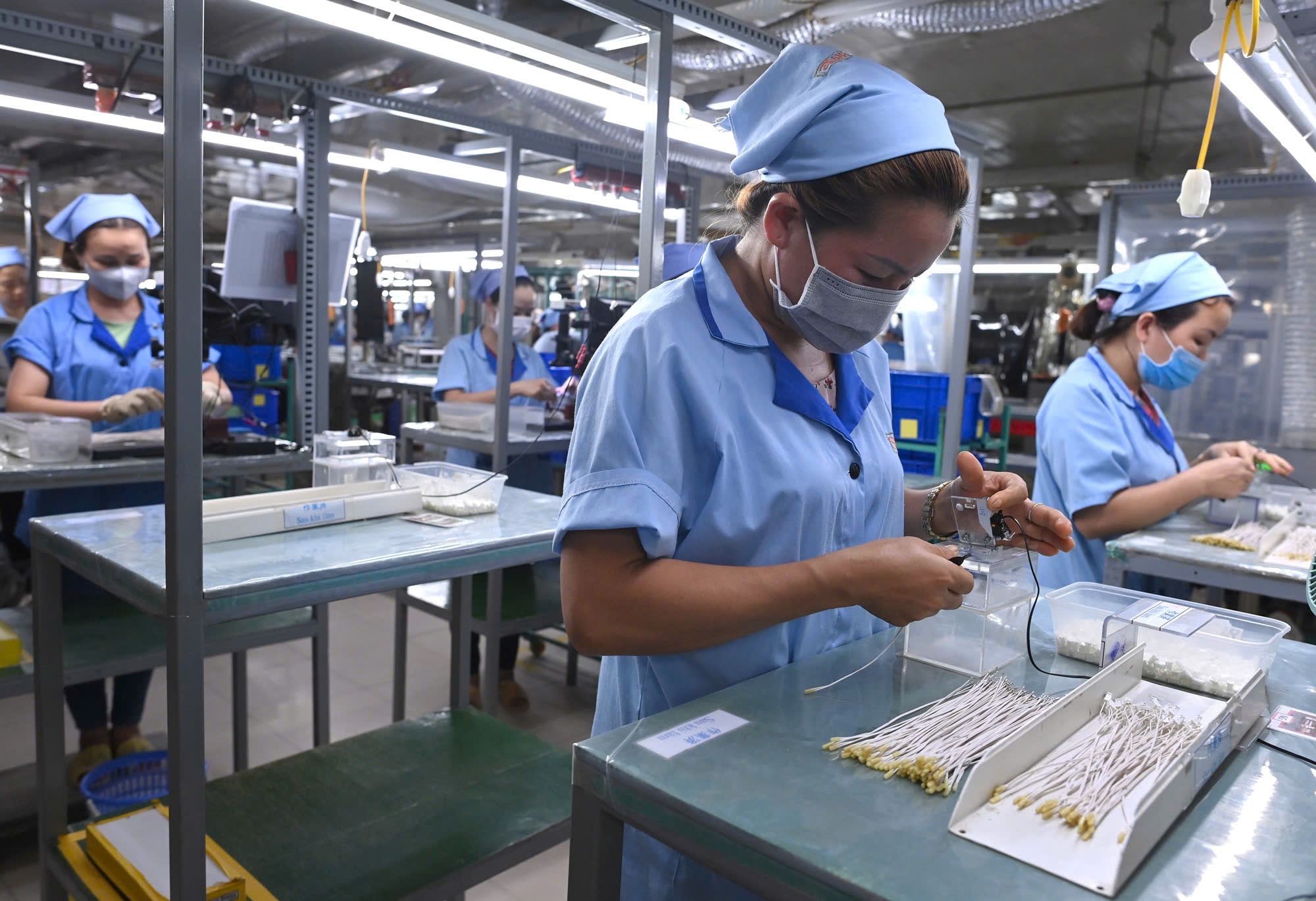
Exports from Vietnam to the United States account for as much as 30% of Vietnam’s export value. Photo: T.L
Economic institutions are the key—the driver of all drivers—to transforming the growth model and restructuring the economy to make the private sector its most important driving force. This is a crucial time for Vietnam to review and assess its economic institutions to prepare thoroughly for its transition to upper-middle-income status by 2030, with a view to becoming a high-income country by 2045.
Overall, Vietnam’s economic institutions still offer considerable room for reform so that they can truly underpin the next stage of development. Given the goal of becoming a developed, high-income country by 2045, economic institutional reform clearly must come first. Vietnam’s economic institutions must be designed to inspire all citizens and businesses to innovate and harness the potential of the nation and the times to reach beyond its borders. Authority must be delegated to individual officials, civil servants, and public employees so that everyone feels secure in making decisions and taking responsibility in the interests of citizens, businesses, and the country.
+ As you have just mentioned, Professor, the United States’ new tariff policy provides another impetus for us to restructure the economy, strengthen its resilience, and rely on the private sector, placing it at the very center. How, then, should institutions be reformed to inspire the private sector to develop and the country to become strong and prosperous?
– Economic institutional reform includes reform of the economic legal system and the state management apparatus.
We need to continue improving legislation based on four main principles: (i) Reform the approach to lawmaking to ensure both effective state management and the promotion of creativity, abandoning the mindset of “ban what cannot be controlled”; (ii) Minimize administrative intervention; (iii) Improve enforcement effectiveness; and (iv) Ensure equality and transparency in business.
Meanwhile, improvements to the state apparatus should follow three principles: Remove structural barriers, minimize bureaucracy and overlapping functions, and strengthen macroeconomic governance and management capacity; shift the mindset from “doing things on behalf of” the private sector to guiding, supporting, and facilitating its development; and become more transparent and effective, focusing on infrastructure, institutions, social welfare, and science and technology to drive sustainable development.
Source: Nha bao & Cong luan
This is an automated translation. If you notice any errors, please contact the Department of Communications, National Economics University at phongtruyenthong@neu.edu.vn.



