
Press Release on the Policy Dialogue Seminar “U.S. Reciprocal Tariff Policy: Impacts and Strategic Adjustments for Vietnam”
05/05/2025 2025-05-05 9:32Press Release on the Policy Dialogue Seminar “U.S. Reciprocal Tariff Policy: Impacts and Strategic Adjustments for Vietnam”
Press Release on the Policy Dialogue Seminar “U.S. Reciprocal Tariff Policy: Impacts and Strategic Adjustments for Vietnam”
MINISTRY OF EDUCATION AND TRAINING (MOET)
NATIONAL ECONOMICS UNIVERSITY (NEU)
————
Press Release on the Policy Dialogue Seminar:
“U.S. Reciprocal Tariff Policy: Impacts and Strategic Adjustments for Vietnam”
I. Background
In recent years, U.S. tariff policy has become a strategic tool in international trade policy, particularly amid economic and technological competition among major economies. The United States uses reciprocal tariff measures (retaliatory tariffs) to respond to trade practices it considers unfair, in violation of WTO commitments, or harmful to its domestic economy. Reciprocal tariff policy affects not only major partners such as China and the EU but also has ripple effects on many other countries linked to global supply chains, including Vietnam. U.S. increases or adjustments to reciprocal tariffs cause major shifts in trade and investment flows and the structure of global value chains.
The U.S. announcement of reciprocal tariffs sent shock waves around the world. For Vietnam, the United States announced a tariff rate of 46%; without a positive negotiation outcome securing a 90-day postponement of its implementation, this would be a major shock to Vietnam’s economy. These 90 days provide Vietnam with time to prepare for negotiations on a reciprocal trade agreement, with a commitment to safeguarding national interests, ensuring fair trade, balancing interests, and sharing risks.
Currently, exports from Vietnam to the United States account for as much as 30% of Vietnam’s total export value, while its trade surplus with the United States represents more than 20% of the economy’s total GDP. In terms of composition, 70% of goods exported to the United States are key manufactured and processed products, such as electrical goods, electronics, components, phones, leather goods and footwear, textiles and garments, and wood products. These goods are largely produced by the foreign direct investment (FDI) sector, which has also been a driver of the economy in recent years. These tariffs therefore have a substantial impact on both exports and the FDI sector, directly hitting the economy’s most important drivers. This, in turn, has a major impact on growth and causes macroeconomic instability.
Whatever the outcome, this period gives Vietnam time to prepare measures to respond to the changes and impacts arising from the new U.S. tariff policy. It also presents an opportunity to restructure the economy to achieve self-reliance and sustainable development and strengthen its resilience to global instability.
Against this backdrop, NEU is organizing a policy dialogue seminar on “U.S. reciprocal tariff policy: Impacts and strategic adjustments for Vietnam.” The seminar provides a forum for researchers, experts, and policymakers to exchange views, analyze the nature and impacts of this policy, and propose appropriate strategic measures to help businesses and Vietnam’s economy adapt effectively to changes in U.S. reciprocal tariff policy in the new context.
II. Seminar Objectives and Topics
The seminar’s overall objective is to assess the impacts of U.S. reciprocal tariff policy on Vietnam and, on that basis, propose appropriate directions, response measures, and strategic adjustments in the context of global economic integration.
Specific topics include:
• Assessing the impacts of U.S. reciprocal tariff policy on Vietnam’s overall economy, production industries, and business sector.
• Clearly identifying the risks/challenges as well as opportunities for Vietnam.
• Proposing strategic adjustments and policies to support businesses, industries, and Vietnam’s economy in adapting to U.S. reciprocal tariff policy and enhancing competitiveness in the new context
III. Time and Venue
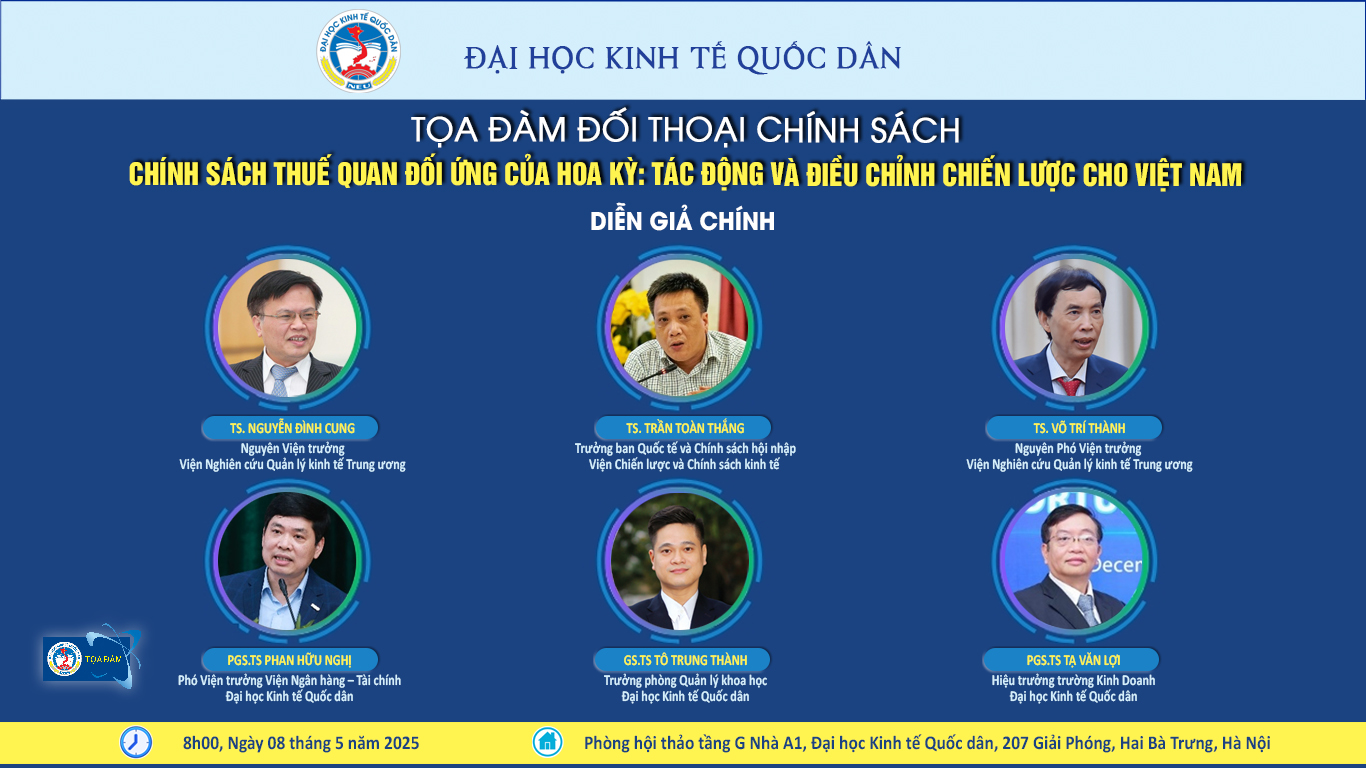
– Time: 8:00 a.m., May 8, 2025 (Thursday);
– Venue: Conference Room, Floor G, Building A1, NEU, 207 Giai Phong Street, Hai Ba Trung, Hanoi.
IV. Participants
The seminar will bring together approximately 80 delegates representing central-level bodies, including the Central Commission for Policy and Strategy, the National Assembly’s Committee for Economic and Financial Affairs, and central ministries, commissions, and agencies; research institutes; universities and higher education institutions; businesses; associations; and economic experts, among others.
The main speakers are:
– Dr. Nguyen Dinh Cung, former Director of the Central Institute for Economic Management
– Dr. Tran Toan Thang, Head of the International Affairs and Integration Policy Division, Institute for Economic Strategy and Policy
– Dr. Vo Tri Thanh, former Deputy Director of the Central Institute for Economic Management
– Assoc. Prof. Dr. Phan Huu Nghi, Vice Dean of the School of Banking and Finance, NEU
– Prof. Dr. To Trung Thanh, Head of the Department of Research Management, NEU
– Assoc. Prof. Dr. Ta Van Loi, Rector of the College of Business, NEU
– Prof. Dr. Tran Tho Dat, NEU
– Prof. Dr. Nguyen Ke Tuan, NEU
– Prof. Dr. Hoang Van Hoa, NEU
– Prof. Dr. Tran Thi Van Hoa, NEU
– Prof. Dr. Ngo Thang Loi, NEU
The event program is attached to this press release.
For information about the seminar, please contact:
MSc. Vu Phuong Linh, Department of Communications, NEU, mobile: 0973.256.257, email: linhvp@neu.edu.vn
MSc. Bui Huy Hoan, Department of Research Management, NEU, mobile: 0965.666.857, email: hoanbh@neu.edu.vn
Thank you for your attention.
Organizing Committee
This is an automated translation. If you notice any errors, please contact the Department of Communications, National Economics University at phongtruyenthong@neu.edu.vn.



