
Toward the Vietnam Economic Conference 2024 and the Release of the Annual Vietnam Economic Review: Prof. Dr. To Trung Thanh — Focus on Demand-Side Policies to Meet the 2024 Growth Target
05/03/2024 2024-03-05 10:02Toward the Vietnam Economic Conference 2024 and the Release of the Annual Vietnam Economic Review: Prof. Dr. To Trung Thanh — Focus on Demand-Side Policies to Meet the 2024 Growth Target
Toward the Vietnam Economic Conference 2024 and the Release of the Annual Vietnam Economic Review: Prof. Dr. To Trung Thanh — Focus on Demand-Side Policies to Meet the 2024 Growth Target
(Vneconomy) – Although challenges remain pervasive, the economic upturn in the first two months of the year has sparked hopes of meeting the 2024 growth target and building momentum to complete the five-year plan…

Room for monetary policy is gradually running out, fiscal policy support for growth has fallen short of expectations, and businesses facing numerous disadvantages have had little choice but to scale back and wait for opportunities.
Global economic instability and the bleak outlook for Vietnam’s major trading partners (such as the United States, the EU and China) will certainly slow domestic GDP growth. Adverse factors and uncertainties in the global economy have led to downward revisions in all forecasts for Vietnam’s growth in 2024 compared with 2023. Resolution No. 103/2023/QH15 dated November 9, 2023, on the Socioeconomic Development Plan for 2024 sets a full-year GDP growth target of approximately 6–6.5%, more optimistic than forecasts by international organizations.
The year 2024 is particularly important: it must be a year of acceleration and breakthroughs in implementing the 2021–2025 Five-Year Socioeconomic Development Plan, which targets average growth of 6.5–7%.

Prof. Dr. To Trung Thanh, Head of the Department of Research Management, National Economics University (NEU)
A Smooth Start, but Difficulties Remain Pervasive
The smooth start in the first two months of 2024 has raised expectations of more favorable results for the full year. Data from the General Statistics Office show that total merchandise import and export turnover in the first two months of 2024 was estimated at USD 113.96 billion, up 18.6% year over year. Total registered foreign investment in Vietnam as of February 20, 2024, reached nearly USD 4.29 billion, up 38.6%; disbursed foreign investment was estimated at USD 2.8 billion, up 9.8%.
Meanwhile, the index of industrial production (IIP) was estimated to have risen by 5.7% (compared with a 2.9% decline in the same period of 2023). Nationwide, 41,100 businesses were newly registered or resumed operations, up 8.5% year over year. Despite these positive signals, some economic indicators in February 2024 still recorded declines or some stagnation compared with the previous month and the same period last year.
Reviewing the challenges of 2023 is necessary to manage policy more effectively this year. The year 2023 was considered one of the most difficult for Vietnam’s economy in recent years.

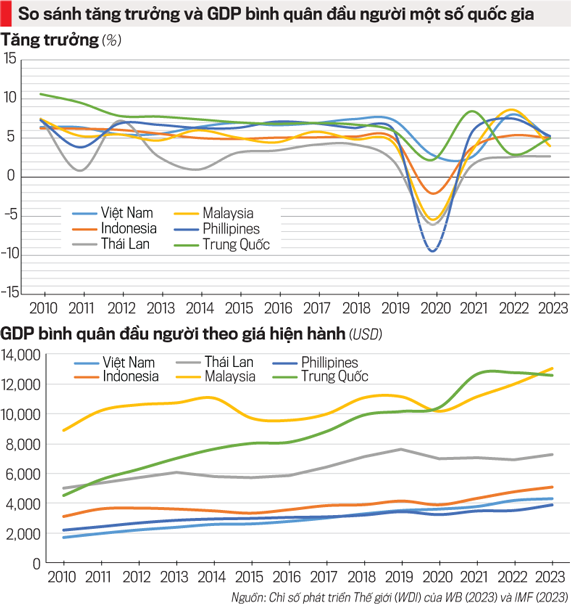
Against a backdrop of numerous risks and uncertainties—including a global economy that had yet to recover fully from Covid-19, persistently high global inflation, central banks continuing to pursue tight monetary policies, slowing growth in many major economies, and political factors such as the continuing complexity of the Russia–Ukraine war and escalating Israel–Hamas conflict—Vietnam’s growth in 2023 fell sharply from the 8.02% recorded in 2022 and fell short of the Government’s 6.5% target.
This figure was also much lower than the pre-pandemic growth rates of 7.47% and 7.36% in 2018 and 2019, respectively. Growth in 2023 exceeded only the rates of 2.87% and 2.55% recorded in the two Covid-19 years of 2020 and 2021. The 2023 growth result clearly reflects a sharp weakening of the components of aggregate demand.
Among the expenditure components of aggregate demand, capital formation increased by 4.09% (compared with 5.04% growth in 2022). Total realized investment across the economy in 2023 at current prices increased by 6.2% year over year (compared with 11.2% in 2022).
Within state-sector investment, disbursements from the state budget reached only 85.3% of the annual plan. Realized investment by the non-state sector increased by only 2.7%, significantly below the 8.9% increase in 2022.
Disbursed foreign direct investment in Vietnam increased by only 5.4%, compared with 13.9% in 2022. The non-state sector’s share of investment fell from 58.2% in 2022 to 56.1%. This reflects the enormous difficulties facing the private sector following the severe and prolonged impact of the pandemic.
Meanwhile, spending and consumption momentum tended to weaken. Final consumption, a component of aggregate demand, increased by only 3.52% (compared with 7.09% in 2022). For 2023 as a whole, total retail sales of goods and consumer service revenue increased by 9.6% from the previous year (compared with 20% in 2022), or 7.1% after adjusting for price changes (compared with 15.8% in 2022). Declining household incomes led to lower consumer demand for goods.
Thus, both final consumption and capital formation grew more slowly than the overall economy. GDP growth of 5.05% was attributable to an improved balance of exports and imports of goods and services at constant prices. The merchandise trade surplus in 2023 was estimated at USD 28 billion, a notable contributor to growth (compared with a surplus of USD 12.1 billion the previous year), contributing 1.6 percentage points to overall growth. However, total merchandise import and export turnover fell by 6.6% from the previous year, with exports declining by 4.4% and imports by 8.9%.
The large trade surplus actually resulted from import growth being lower than export growth. Statistics over many years show that imports of production inputs account for 60%, imports for gross capital formation account for more than 30%, and imports for final consumption account for only nearly 10%. Thus, a sharp fall in import growth also indicates serious production difficulties, particularly in the next production cycle.
Scaling Back Production While Waiting for Opportunities
On the aggregate supply side, agriculture, forestry and fisheries production continued to serve as a pillar of the economy in 2023, growing by 3.83% (compared with 3.36% in 2022), while industry faced numerous difficulties amid declining global aggregate demand.
Value added across industry increased by only 3.02% in 2023 compared with the previous year, the lowest growth rate in the 2011–2023 period. Manufacturing, the mainstay of industrial production, grew by only 3.62%, also its lowest growth rate in the 2011–2023 period.
The manufacturing sector remained weak for most of 2023, with the Purchasing Managers’ Index (PMI) below the 50 threshold in 10 of the 12 months. The annual average PMI was the lowest since the outbreak of the Covid-19 pandemic in 2020.
Business registration figures also reflected numerous difficulties. Nearly 160,000 businesses were newly established in 2023, up 7% from 2022.
Although the number increased, the rate of increase was far below the 27.1% recorded in 2022.
Meanwhile, approximately 58,000 businesses resumed operations, below the 60,000 recorded in 2022. The numbers of businesses temporarily suspending operations and awaiting dissolution procedures stood at 89,000 and 65,000, respectively, both higher than in 2022.
At the same time, the number of businesses suspending operations for a fixed period rose sharply, increasing by more than 15,000 compared with 2022, reflecting the many disadvantages businesses faced in the investment and business environment.
These businesses were struggling, operating inefficiently and lacking viable business plans. They therefore registered temporary suspensions rather than dissolving, giving themselves time to find customers and develop effective business plans. Clearly, many businesses were “barely surviving” and waiting for changes in the external environment to offer an opportunity for recovery.
Building Momentum for Growth in 2024
With no substantive improvement in the economic model, the Government will have to rely primarily on demand-side policies to achieve high growth as early as 2024 (in the short term), from the low growth base of 2023. Growth drivers on the aggregate demand side need to be restored quickly and strengthened further…
This article was published in Vietnam Economic Times, issue 10-2024, released on March 4, 2024. Faculty members and readers are invited to read it here.
Source: Vneconomy
This is an automated translation. If you notice any errors, please contact the Department of Communications, National Economics University at phongtruyenthong@neu.edu.vn.