Press Information on the Policy Dialogue Seminar “Breakthrough Solutions to Remove Bottlenecks to Private Sector Development”
12/08/2025 2025-08-12 16:49Press Information on the Policy Dialogue Seminar “Breakthrough Solutions to Remove Bottlenecks to Private Sector Development”
Press Information on the Policy Dialogue Seminar “Breakthrough Solutions to Remove Bottlenecks to Private Sector Development”
Press Information on the Policy Dialogue Seminar:
“Breakthrough Solutions to Remove Bottlenecks to Private Sector Development”
I. Background
In Resolution No. 68-NQ/TW dated May 4, 2025, the Party Central Committee clearly identified the private sector as one of the most important drivers of the national economy. The Resolution sets the goal of developing the private sector into a pioneering force in science and technology development, innovation and digital transformation—making an important contribution to achieving the objectives of Resolution 57-NQ/TW dated December 22, 2024, on national science and technology development, innovation and digital transformation, as well as other important Party resolutions, such as Resolution 59-NQ/TW on economic integration in the new context and Resolution 66-NQ/TW on lawmaking and law enforcement in the new era. Together, these resolutions form four important pillars for ushering the country into a new phase of breakthrough development.
After nearly 40 years of Doi Moi (Renewal), Vietnam’s private sector has developed strongly in both quantity and quality, gradually affirming its role in the socialist-oriented market economy. By 2024, the sector accounted for 53.4% of total social investment and 82.07% of total employment in the economy, contributing 38.6% of total pretax profits and 51% of total income generated for employees in the enterprise sector. Notably, the private sector contributed 43% of total GDP and accounted for as much as 57% of GDP growth in 2024—the largest contribution among economic sectors. During 2011–2024, the sector recorded average annual growth of 6.3%, exceeding the economy-wide average of 5.48% per year. These figures firmly establish the private sector’s central role and enormous potential, while laying the foundation for elevating its position to that of a primary driver in achieving Vietnam’s goal of rapid and sustainable growth.
Resolution 68-NQ/TW also sets specific targets for 2030 and a vision for 2045, including: striving for 2 million enterprises operating in the economy (equivalent to 20 enterprises per 1,000 people); contributing approximately 55–58% of GDP and 35–40% of total state budget revenue; providing employment for 84–85% of the workforce; achieving average annual labor productivity growth of 8.5–9.5%; and having at least 20 large private enterprises participating in global value chains. By 2045, the goal is to have at least 3 million enterprises, with the private sector contributing more than 60% of GDP and becoming a highly competitive force regionally and globally.
However, the private sector still faces numerous shortcomings relative to expectations that it will become a pillar of national economic development. It currently ranks lowest among economic sectors in business performance, scientific and technological capabilities, labor productivity and employee income. The sector is also showing signs of “losing steam” in its development. This stems from various bottlenecks, including an incomplete understanding of the private sector’s role; insufficiently equitable and inclusive institutions and policies; the absence of an effective model for linkages among the components of the private sector; weak internal capabilities and limited capacity to absorb development resources; and limitations in the quality of the entrepreneurial workforce. These shortcomings must be clearly identified and promptly addressed through breakthrough solutions to enable substantive, robust private sector development and a commensurate contribution to the country’s economic recovery and growth in the new phase.
Against this backdrop, National Economics University (NEU) is organizing a policy seminar on the theme: Breakthrough solutions to remove bottlenecks to private sector development.
II. Objectives and Content of the Seminar
The seminar aims to identify current bottlenecks to private sector development and propose breakthrough solutions to develop the sector into the most important driver of the economy, with a view to contributing to rapid and sustainable growth. The seminar’s outcomes will provide the Party and the State with new insights and breakthrough proposals to help establish coordinated directions and solutions for private sector development in relation to other objectives set out in the important decisions recently issued by the Politburo.
The seminar will address the following specific topics:
– Clarifying the concept, scope, measurement and role of the private sector (formal and informal sectors) in the current context.
– Assessing private sector development in recent years. Assessing the private sector’s role in relation to the state sector and the foreign direct investment (FDI) sector.
– Identifying internal shortcomings and limitations, bottlenecks hindering development, and trends of slowing private sector development amid competition with other economic sectors and in the international environment.
– Assessing, from the perspective of private enterprises, internal shortcomings and limitations and barriers constraining private enterprise development.
– Identifying areas for breakthroughs in private sector development to make it the most important driver of the national economy.
– Proposing breakthrough solutions, from both research and business practice perspectives, to help the private sector overcome barriers, remove bottlenecks and develop into the most important driver of the national economy.
III. Time and Venue
– Time: 8:00 a.m., Friday, August 15, 2025.
– Venue: Conference Room, Floor G, Building A1, NEU, 207 Giai Phong Street, Bach Mai Ward, Hanoi.
IV. Participants
The seminar will bring together approximately 120 delegates representing central agencies, including the Central Commission for Policy and Strategy, the National Assembly’s Economic and Financial Committee, and central ministries, commissions and agencies; research institutes; universities; economic experts; press reporters; and others.
And the Main Speakers:
– Assoc. Prof. Dr. Nguyen Hong Son, Deputy Head of the Central Commission for Policy and Strategy
– Senior Lieutenant General Assoc. Prof. Dr. Nguyen Van Thanh, Vice Chairman of the Central Theoretical Council
– Assoc. Prof. Dr. Pham Van Linh, Vice Chairman of the Central Theoretical Council
– Dr. Hoang Xuan Hoa, Deputy Secretary of the Party Committee of the Office of the National Assembly
– Dr. Nguyen Phi Lan, Director of the Department of Forecasting, Statistics and Monetary and Financial Stability, State Bank of Vietnam
– Le Trung Hieu, Deputy Director General of the National Statistics Office, Ministry of Finance
– Dr. Nguyen Hoang Duong, Deputy Director of the Department of Financial Institutions, Ministry of Finance
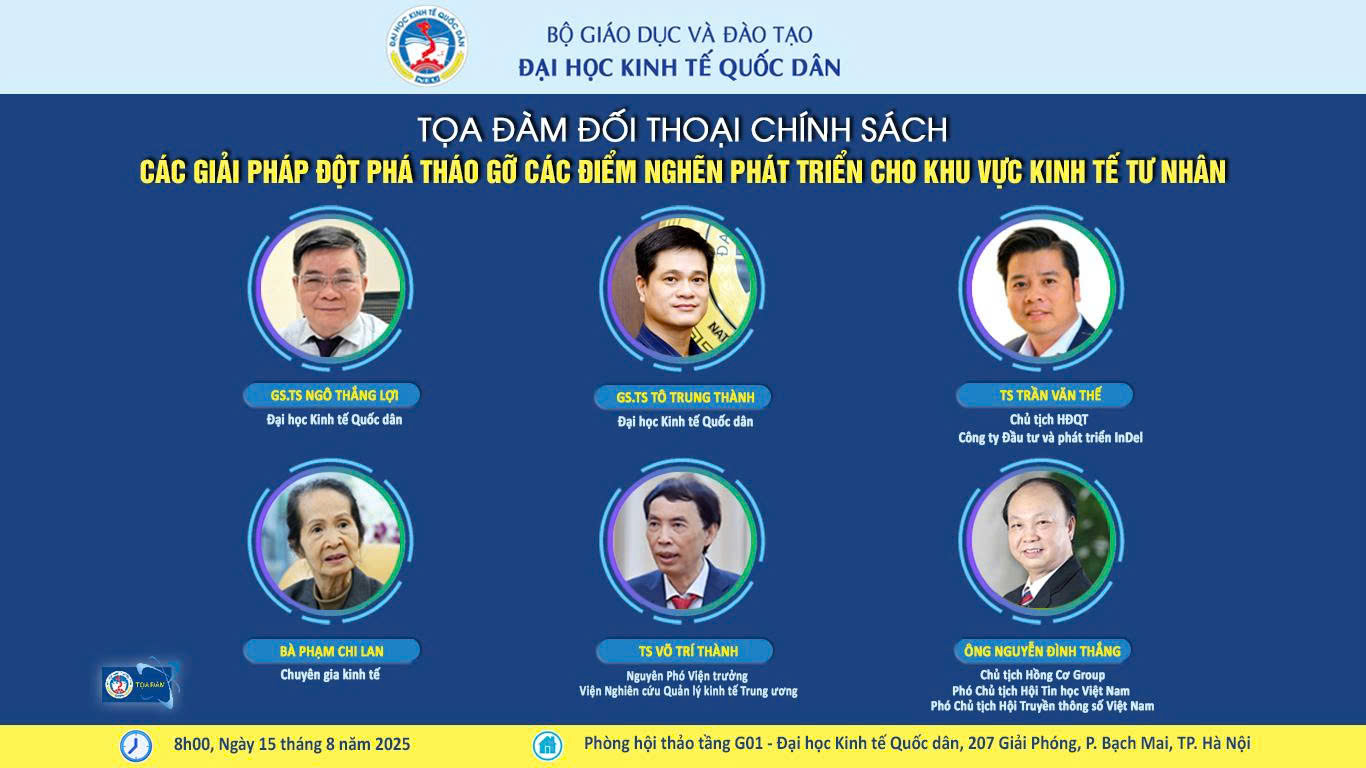
– Nguyen Dinh Thang, Chairman of Hong Co Group, Vice President of the Vietnam Association for Information Processing, and Vice President of the Vietnam Digital Communications Association
– Prof. Dr. Ngo Thang Loi, NEU
– Prof. Dr. To Trung Thanh, Head of the Department of Research Management, NEU
– Dr. Tran Van The, Chairman of the Board of Directors of InDel Investment and Development Company
– Dr. Vo Tri Thanh, former Deputy Director of the Central Institute for Economic Management
– Pham Chi Lan, economic expert
– Dr. Nguyen Thi Luyen, Institute of Policy and Strategy Research
– Assoc. Prof. Dr. Bui Van Huyen, Director of the Institute of Economics, Ho Chi Minh National Academy of Politics
– Assoc. Prof. Dr. Le Xuan Ba, former Director of the Central Institute for Economic Management
– Assoc. Prof. Dr. Vu Sy Cuong, Academy of Finance
– Hoang Cong Doan, Vice President of the Vietnam Young Entrepreneurs Association
– Dr. Nguyen Van Dinh, Vice President of the Vietnam National Real Estate Association and President of the Vietnam Association of Realtors
– Tuan Ha, Member of the Executive Committee of the Vietnam E-commerce Association
– Dr. Nguyen Anh Tuan, Director of the Institute of Tourism Economics, Vietnam Tourism Association
For information about the seminar, please contact:
MSc. Vu Phuong Linh, Department of Communications, NEU; mobile: 0973.256.257; email: linhvp@neu.edu.vn
MSc. Bui Huy Hoan, Department of Research Management, NEU; mobile: 0965.666.857; email: hoanbh@neu.edu.vn
Please take note of this announcement.
Organizing Committee
This is an automated translation. If you notice any errors, please contact the Department of Communications, National Economics University at phongtruyenthong@neu.edu.vn.