National Scientific Conference “Vietnam (1945–2025): An 80-Year Journey of Development — Theoretical and Practical Issues”
14/08/2025 2025-08-14 16:46National Scientific Conference “Vietnam (1945–2025): An 80-Year Journey of Development — Theoretical and Practical Issues”
National Scientific Conference “Vietnam (1945–2025): An 80-Year Journey of Development — Theoretical and Practical Issues”
To mark the 80th anniversary of the National Day of the Socialist Republic of Vietnam (September 2, 1945–September 2, 2025), National Economics University (NEU) held the national scientific conference “Vietnam (1945–2025): An 80-Year Journey of Development — Theoretical and Practical Issues” on August 14.
The conference provided a forum for scientists, researchers, experts, and managers to exchange views on theoretical and practical issues in the process of national construction, defense, and development; explore new approaches; and contribute scientific foundations for teaching and research in Marxist-Leninist disciplines and Ho Chi Minh Thought.
Attending the conference from outside the University were Assoc. Prof. Dr. Vu Thanh Son, Director of the Department of Personnel Training and Development, Central Organization Commission; Dr. Luong Cong Ly, Department of Political Theory, Central Commission for Information, Education and Mass Mobilization; Dr. Vo Van Be, Deputy Director and Deputy Editor-in-Chief of the National Political Publishing House Truth; Dr. Dang Kim Oanh, Editor-in-Chief of the Journal of Party History; Assoc. Prof. Dr. Pham Quoc Thanh, Rector of Thai Binh University; and Dr. Pham Hoang Giang, Dean of the Faculty of Philosophy, University of Social Sciences and Humanities.
Representing NEU were Dr. Nguyen Thi Hoan, Dean of the Faculty of Political Theory; Dr. Nguyen Thi Hao, Vice Dean of the Faculty of Political Theory; along with former Faculty leaders, scientists, contributing authors, and lecturers from the Faculty of Political Theory.
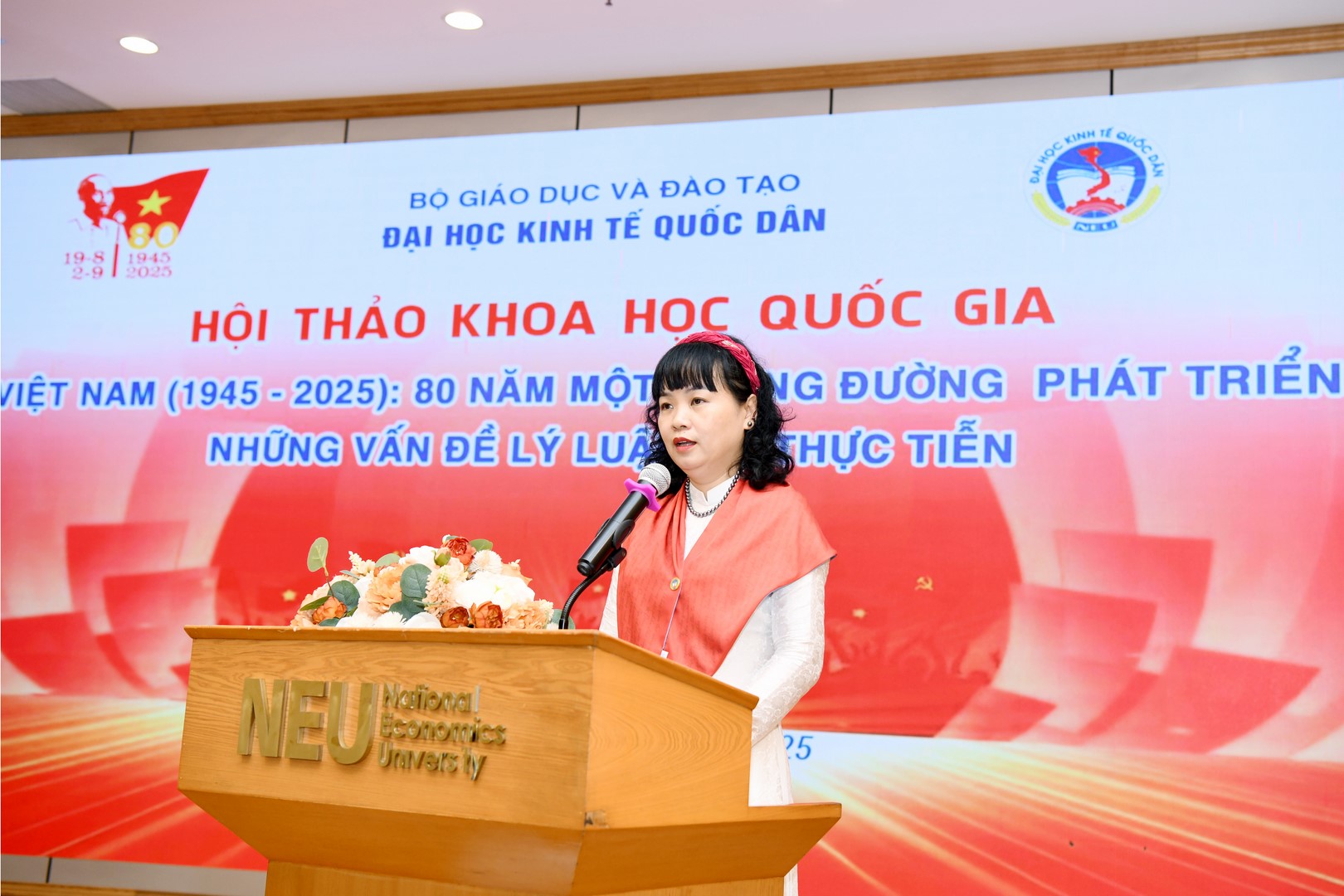
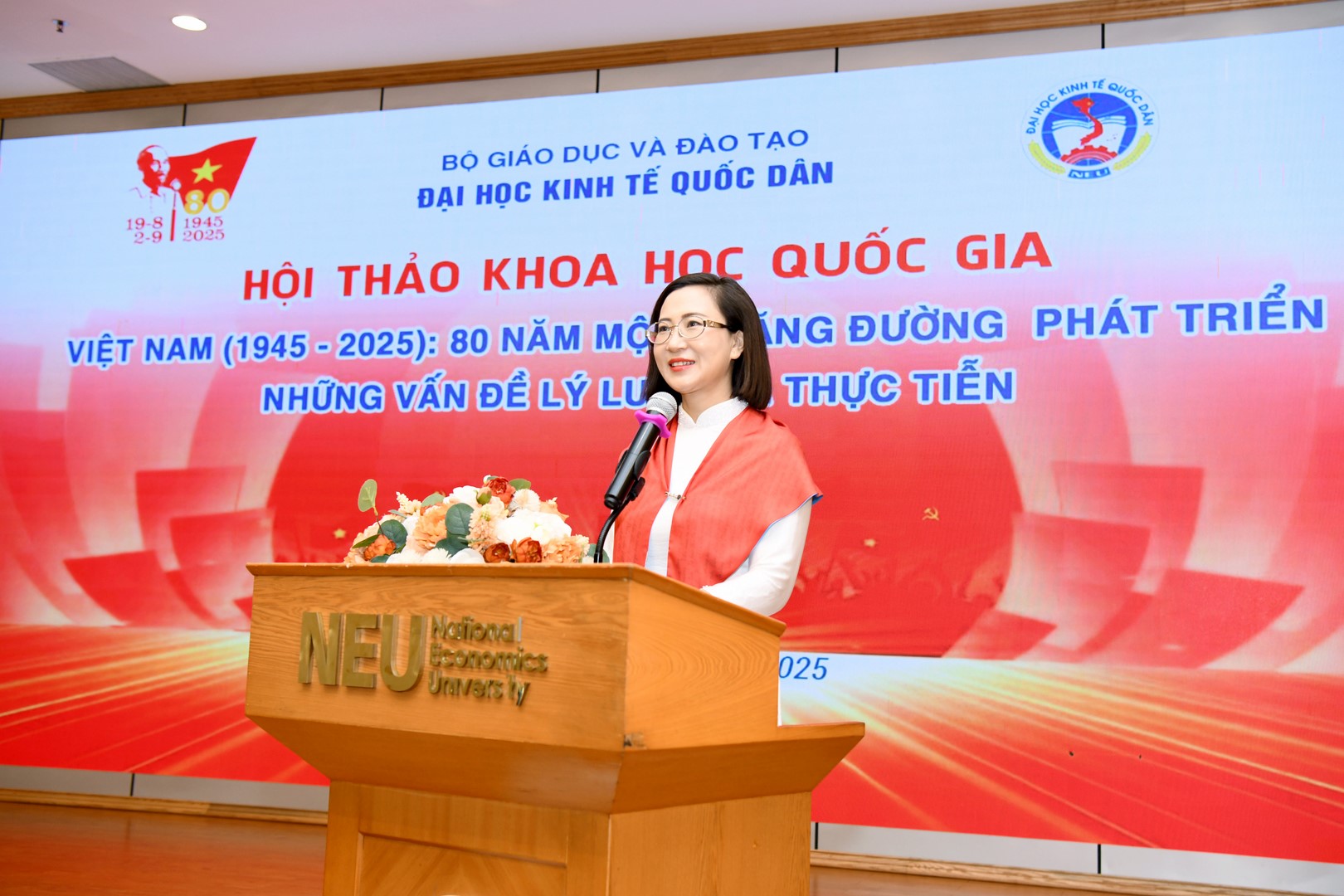
Dr. Nguyen Thi Hoan, Dean of the Faculty of Political Theory, NEU, speaks at the conference
In her introductory remarks, Dr. Nguyen Thi Hoan, Dean of the Faculty of Political Theory, NEU, noted that the conference had attracted widespread interest among scientists, receiving 165 papers from nearly 70 agencies and organizations nationwide. These included numerous universities and research institutes in various fields, such as economics, engineering, social sciences and humanities, teacher education, military affairs, and security.
Discussions at the conference focused on two major themes: “Vietnam (1945–2025): Achievements and Lessons” and “The Nation’s Era of Ascendancy: Prospects and Challenges.” Under the theme “Vietnam (1945–2025): Achievements and Lessons,” papers focused on analyzing the application of Marxism-Leninism to Vietnam’s realities, Ho Chi Minh Thought, and the leadership of the Communist Party of Vietnam over the past 80 years in national defense, construction, and development across all fields. They affirmed the achievements attained and drew lessons spanning the struggle for national liberation, the building of socialism, and the renewal process in the era of national independence.
Under the theme “The Nation’s Era of Ascendancy: Prospects and Challenges,” papers focused on issues facing Marxism-Leninism in the era of ascendancy, the value of applying Ho Chi Minh Thought, and the leadership of the Communist Party of Vietnam in the new era. They examined the challenges intertwined with prospects and favorable conditions, as well as the steadfast commitment to national independence linked to socialism as the country enters a new era, working toward an independent, peaceful, free, and developed Vietnam.
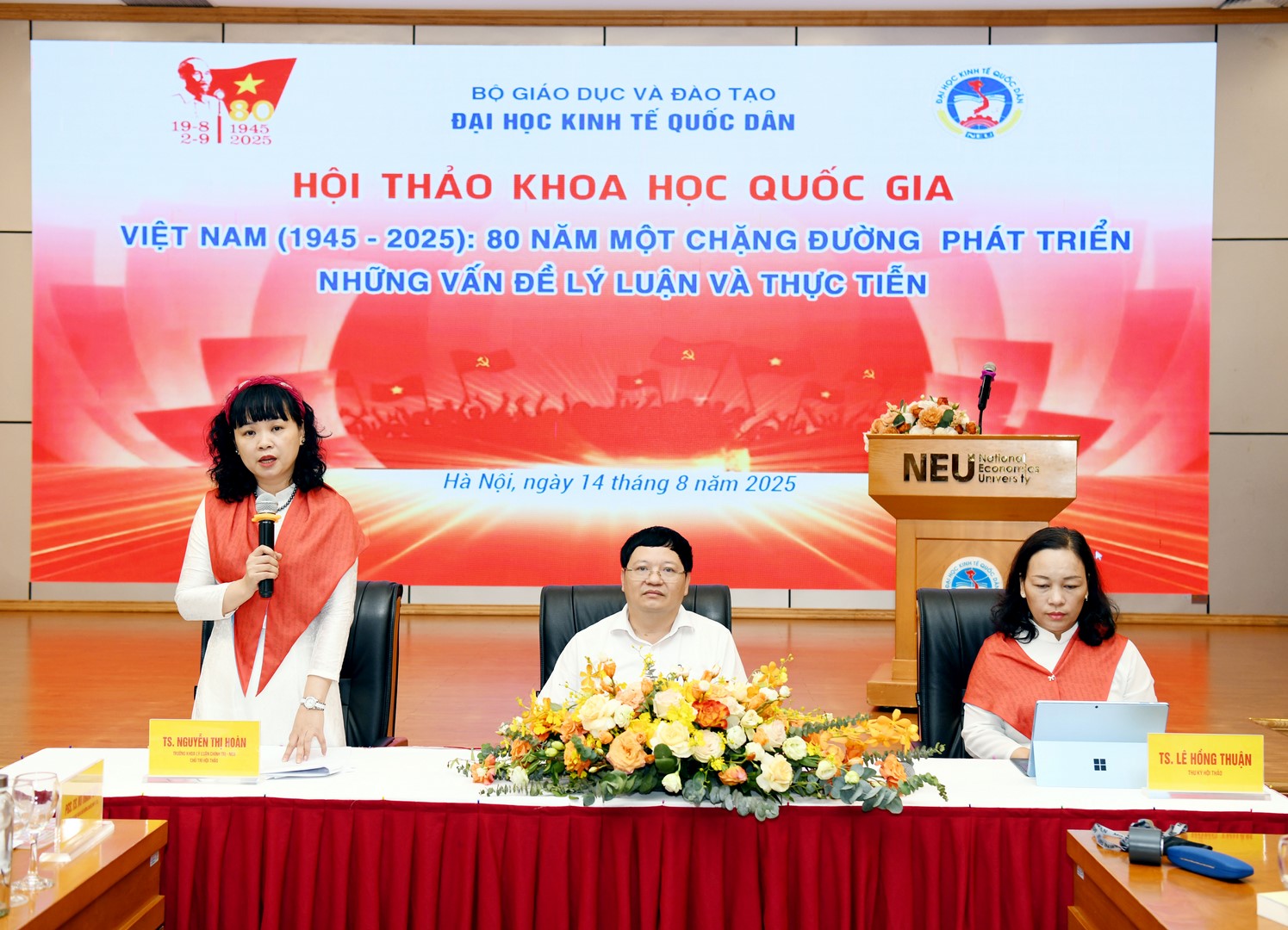
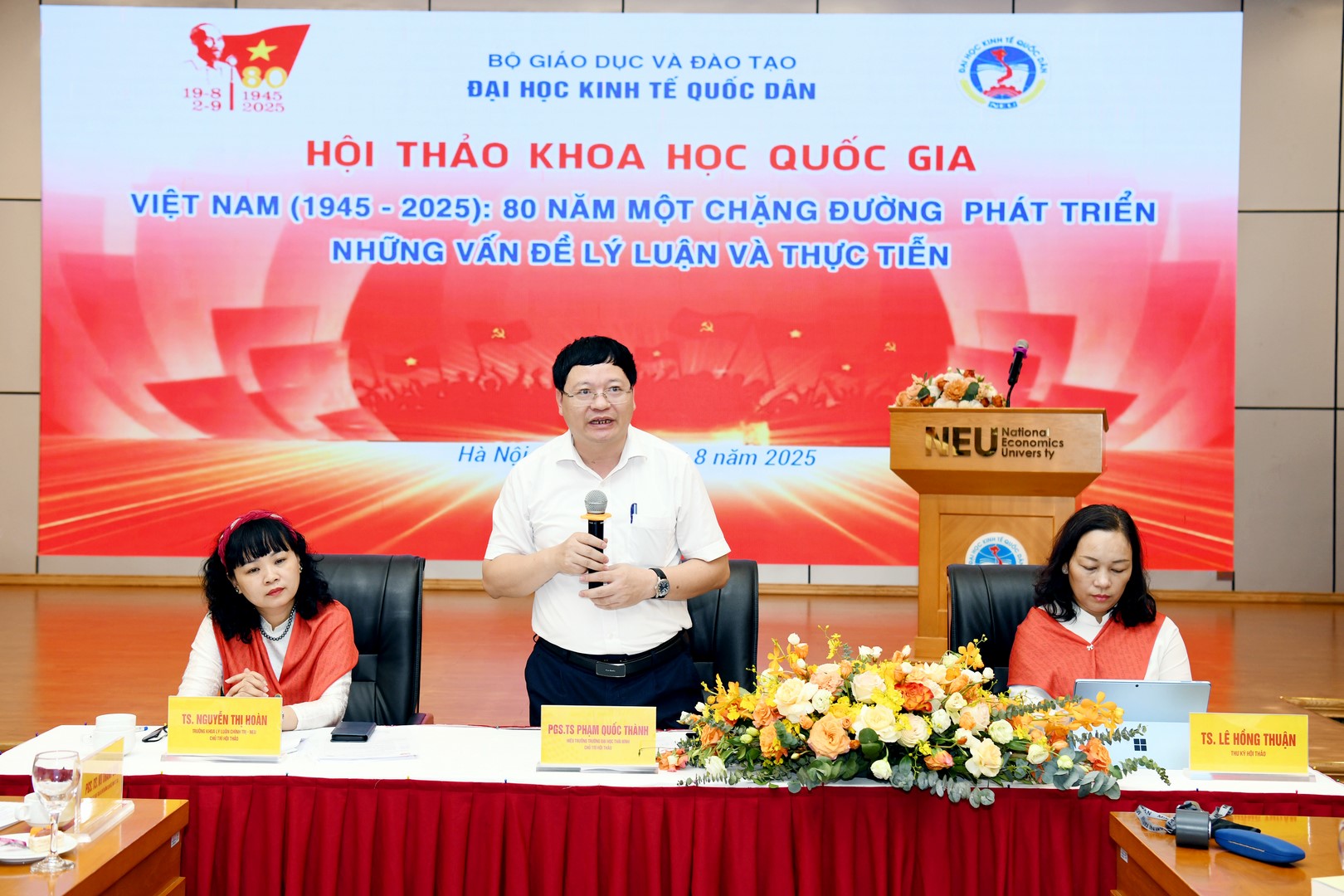
The presiding panel moderates the conference
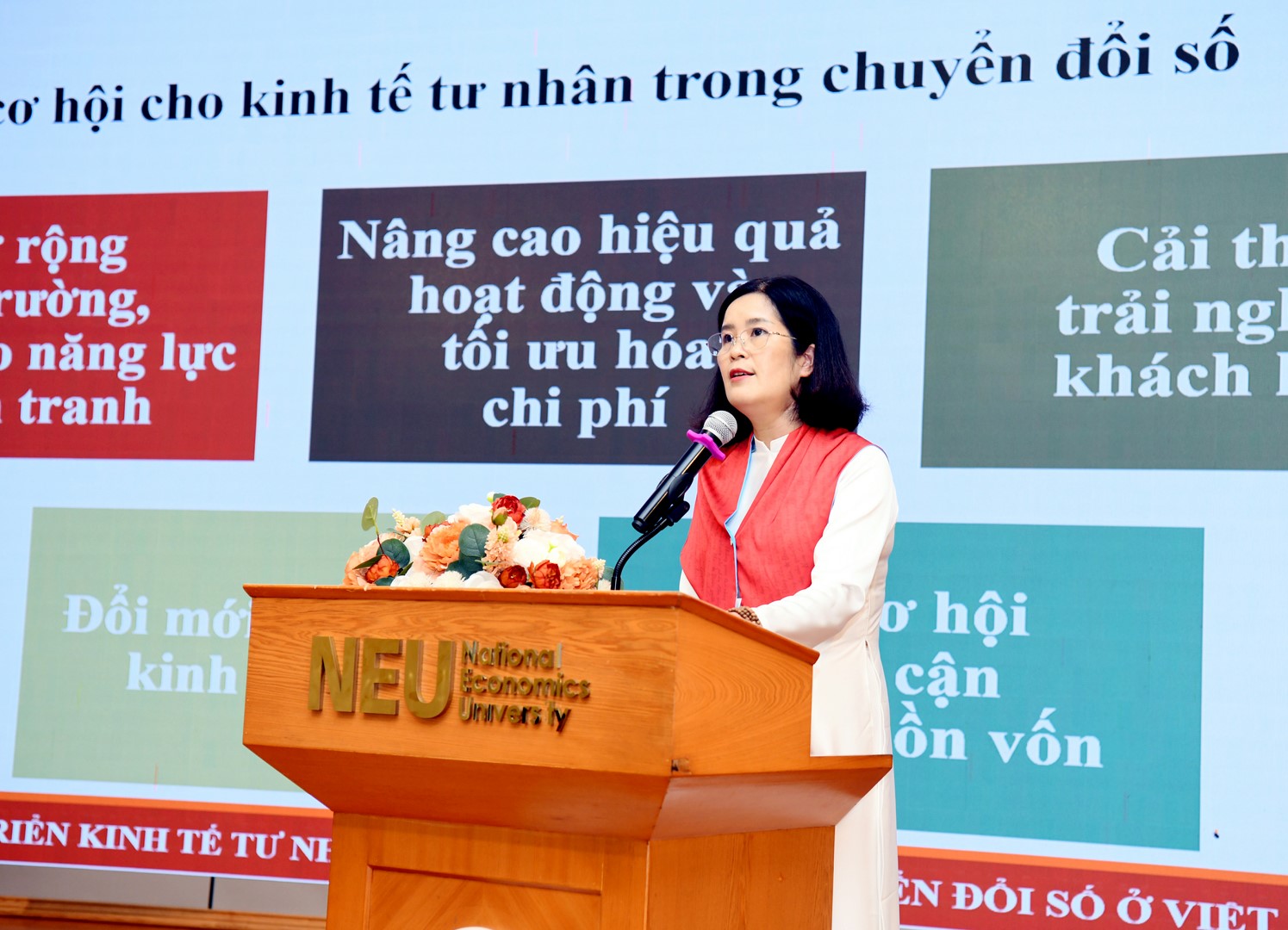
Dr. Nguyen Thi Hao, Faculty of Political Theory, NEU, presents her paper: Private sector development in the context of digital transformation in Vietnam
Addressing private sector development in the context of digital transformation in Vietnam at the conference, Dr. Nguyen Thi Hao, Faculty of Political Theory, NEU, noted that amid the current digital transformation, the private sector plays a pivotal role while also undergoing profound changes. Digital transformation creates both opportunities and challenges for this sector, requiring private enterprises to adapt and innovate rapidly to survive and grow.
In this context, the private sector, as a dynamic sector, faces opportunities for major breakthroughs. However, private enterprises in Vietnam still encounter numerous barriers to digitization related to internal capabilities and digital infrastructure. Clearly identifying these opportunities and challenges provides a basis for developing appropriate solutions to help this economic sector effectively leverage digital transformation for sustainable development in the coming period.
To promote private sector development in this context, Dr. Nguyen Thi Hao proposed several solutions, including improving institutions, policies, and the legal environment; providing financial support and access to capital; developing digital infrastructure and shared digital platforms; and promoting linkages and legal compliance. Coordinated implementation of these solutions will help the private sector effectively leverage digitization, develop sustainably, and contribute positively to the country’s industrialization and modernization.
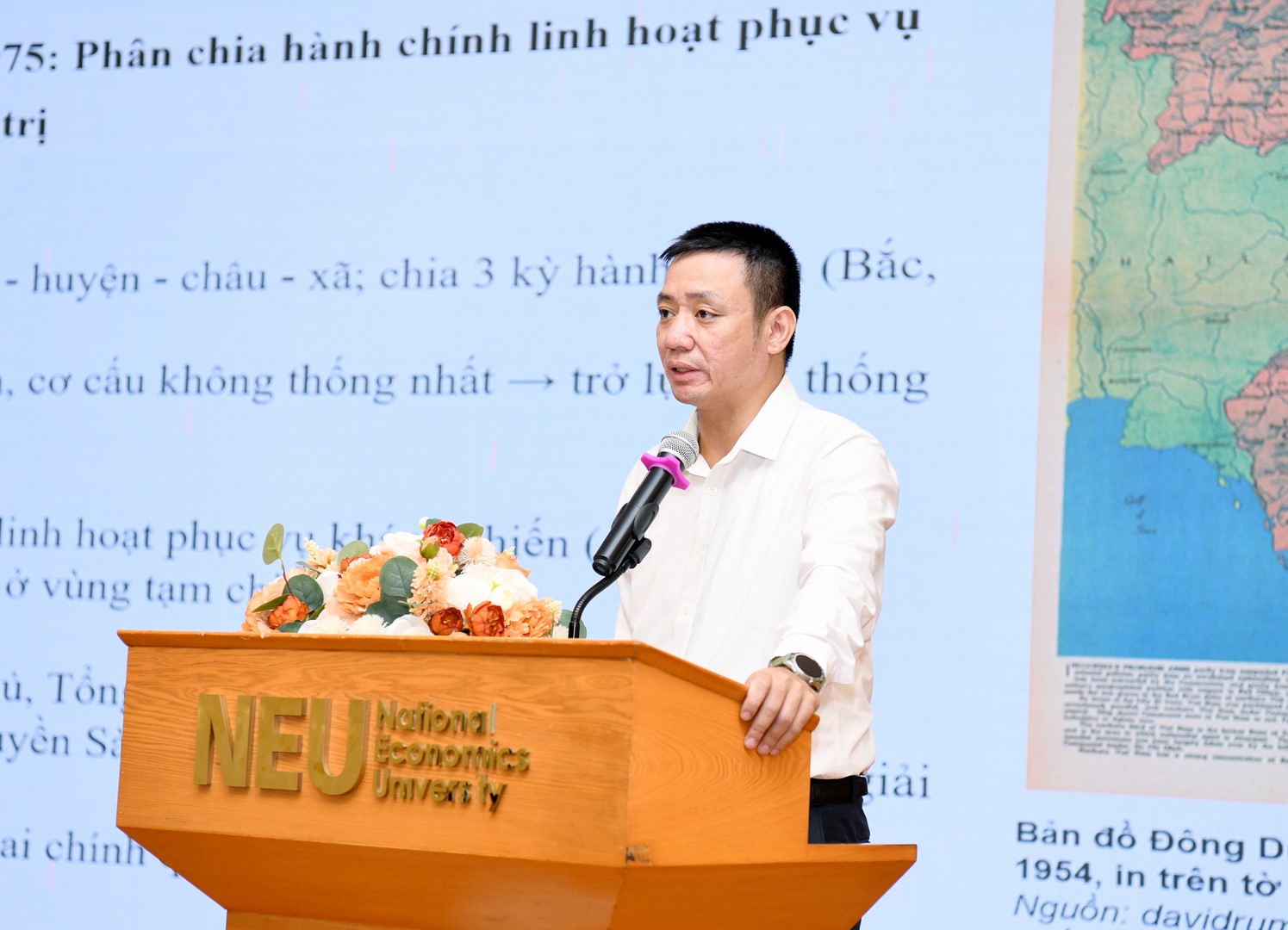
Dr. Pham Van Gieng, Faculty of Political Education, Hanoi Pedagogical University 2, presents his paper: The merger of commune- and district-level administrative units in Vietnam over the past 80 years (1945–2025): A national governance perspective
In his paper analyzing the merger of local administrative units at the commune and district levels in Vietnam over the past 80 years (1945–2025) from a national governance perspective, Dr. Pham Van Gieng, Faculty of Political Education, Hanoi Pedagogical University 2, stated that the merger of administrative units in Vietnam during 1945–2025 represents a series of efforts to adjust the organizational model of the state apparatus, reflecting the political system’s adaptation to historical, social, and economic changes and national development requirements. This is not merely an administrative organizational solution but also a clear expression of institutional reform thinking, demonstrating political determination to build a streamlined, effective public administration that is close to the people.
However, according to Dr. Pham Van Gieng, historical experience shows that the reorganization of administrative boundaries must be closely linked to state governance capacity, political and cultural representation, and social consensus. If not adequately anticipated, challenges involving infrastructure, personnel management, the allocation of power, the preservation of local identity, and public sentiment will undermine reform effectiveness and create consequences that are difficult to remedy in the long term. Therefore, for administrative unit mergers to truly become a driver of national development, policy must shift from an administrative and technical approach to a governance and institutional approach, emphasizing adaptive institutional design, management modernization, substantive decentralization, representation, and community cohesion. This process must also be integrated with regional development planning, digital transformation, and sustainable development goals, in line with the requirements of building a socialist rule-of-law state in the new period.
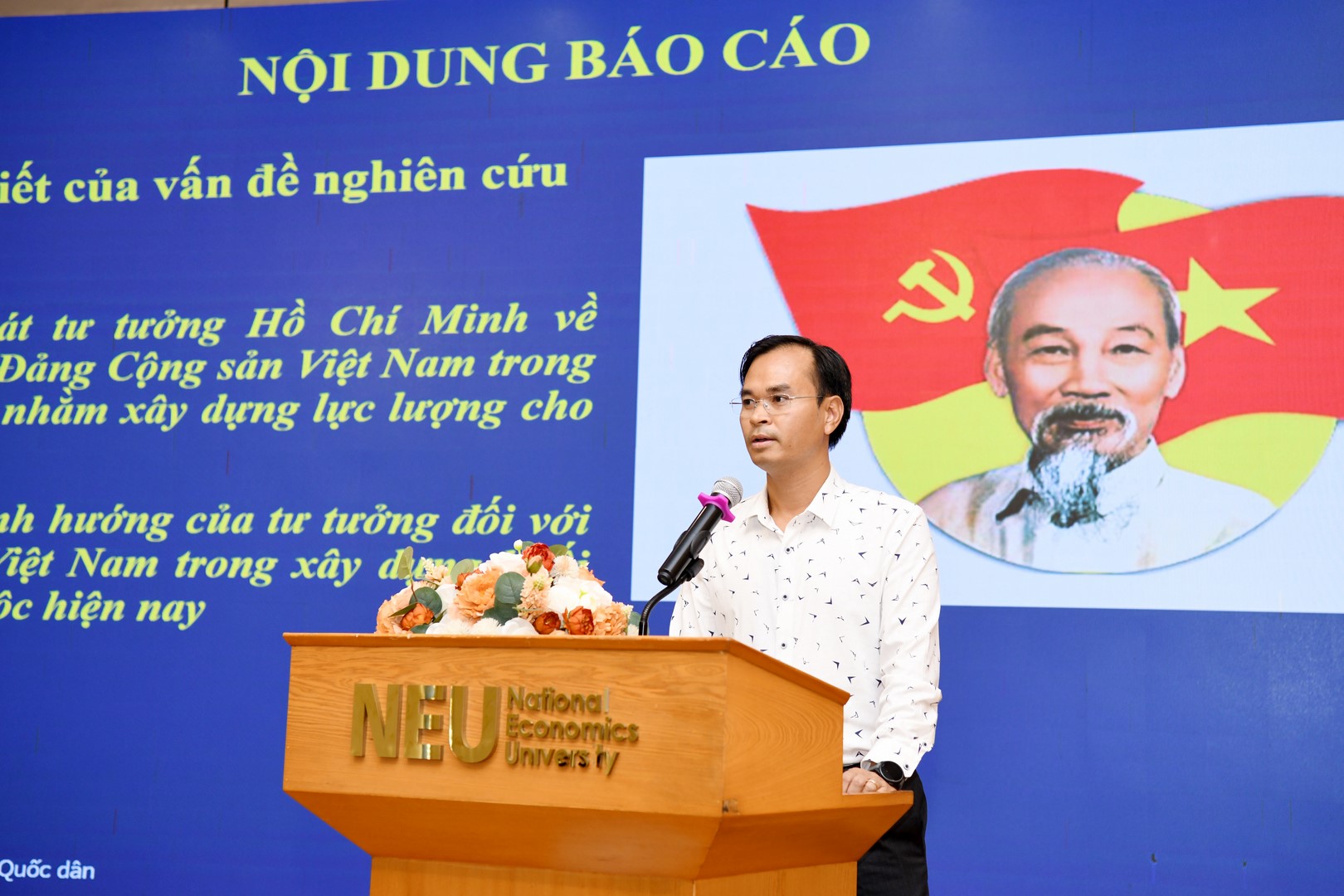
Dr. Nguyen Chi Thien, NEU, presents his paper: Ho Chi Minh Thought on the responsibility of the Communist Party of Vietnam to foster national unity to build revolutionary forces and the guiding value of this thought today
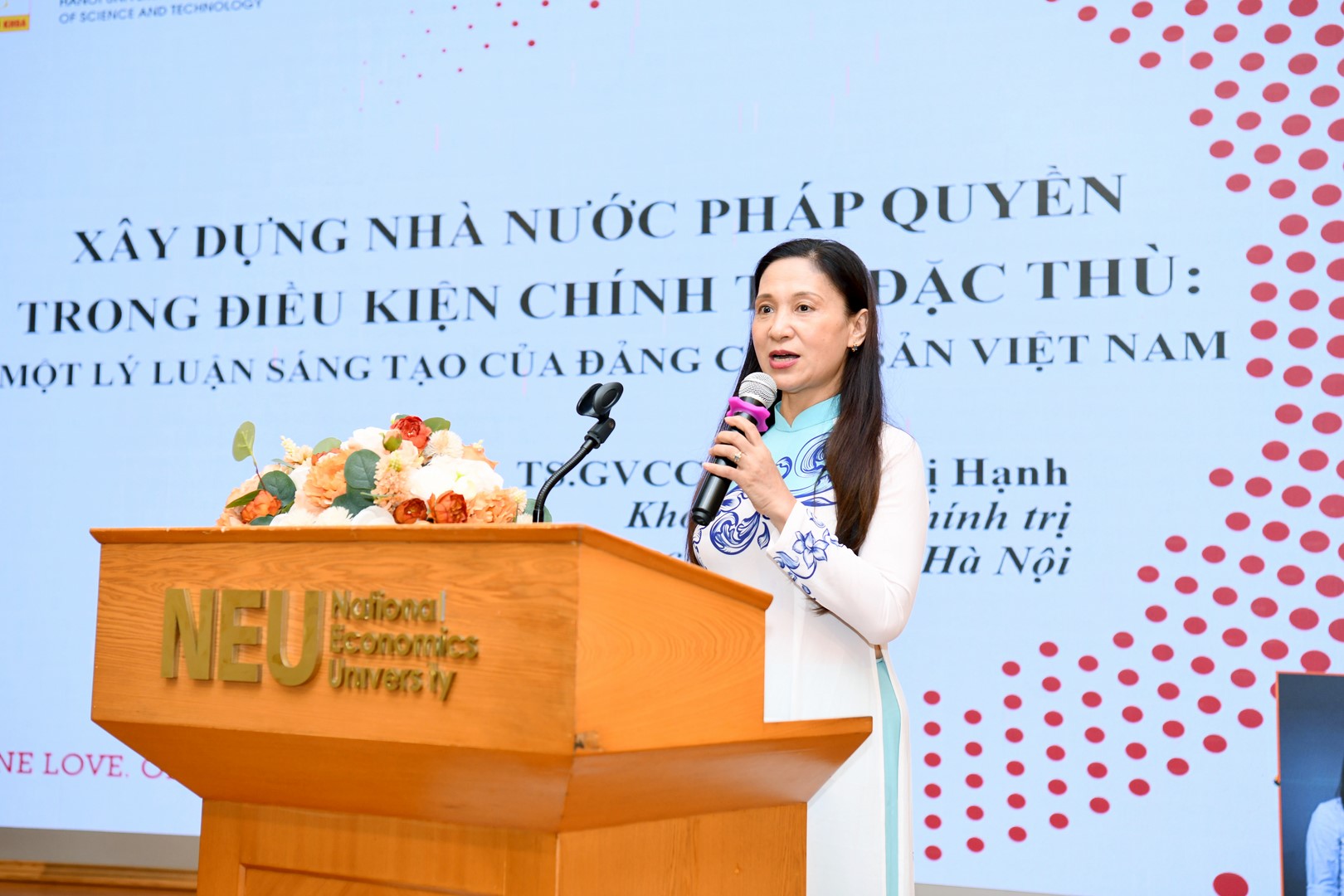
Dr. Hoang Thi Hanh, Hanoi University of Science and Technology, presents her paper: Building a rule-of-law state under specific political conditions — An innovative theory of the Communist Party of Vietnam
Addressing the building of a socialist rule-of-law state under Vietnam’s specific political conditions, Dr. Hoang Thi Hanh, Hanoi University of Science and Technology, explained that to become a developed country with a socialist orientation, Vietnam does not mechanically replicate bourgeois principles and theories of the rule of law, but instead builds a rule-of-law state based on its specific political conditions. The Communist Party of Vietnam promptly advocated research into the theory of the socialist rule-of-law state and gradually undertook concrete measures, including reforming the state administrative apparatus, enhancing the National Assembly’s operational capacity, providing professional training for Government officials and civil servants, closely supervising judicial activities, strengthening and expanding forms of democratic participation, advancing education to raise public knowledge, and providing legal education.
Dr. Hoang Thi Hanh argued that the reform of the state apparatus toward a streamlined yet effective structure, currently directed by General Secretary To Lam, demonstrates that under present conditions, “it is necessary to consider executive mechanisms, fairness under the rule of law, and the integrity of the Government and the state, and to strengthen corruption prevention and control to demonstrate the integrity of the administrative apparatus. These are criteria for assessing the efficiency and effectiveness of the state apparatus and government.” This is also a key step in removing “institutional bottlenecks.” Once this bottleneck is removed, it will surely usher in an era of development, prosperity, and strength for the country.
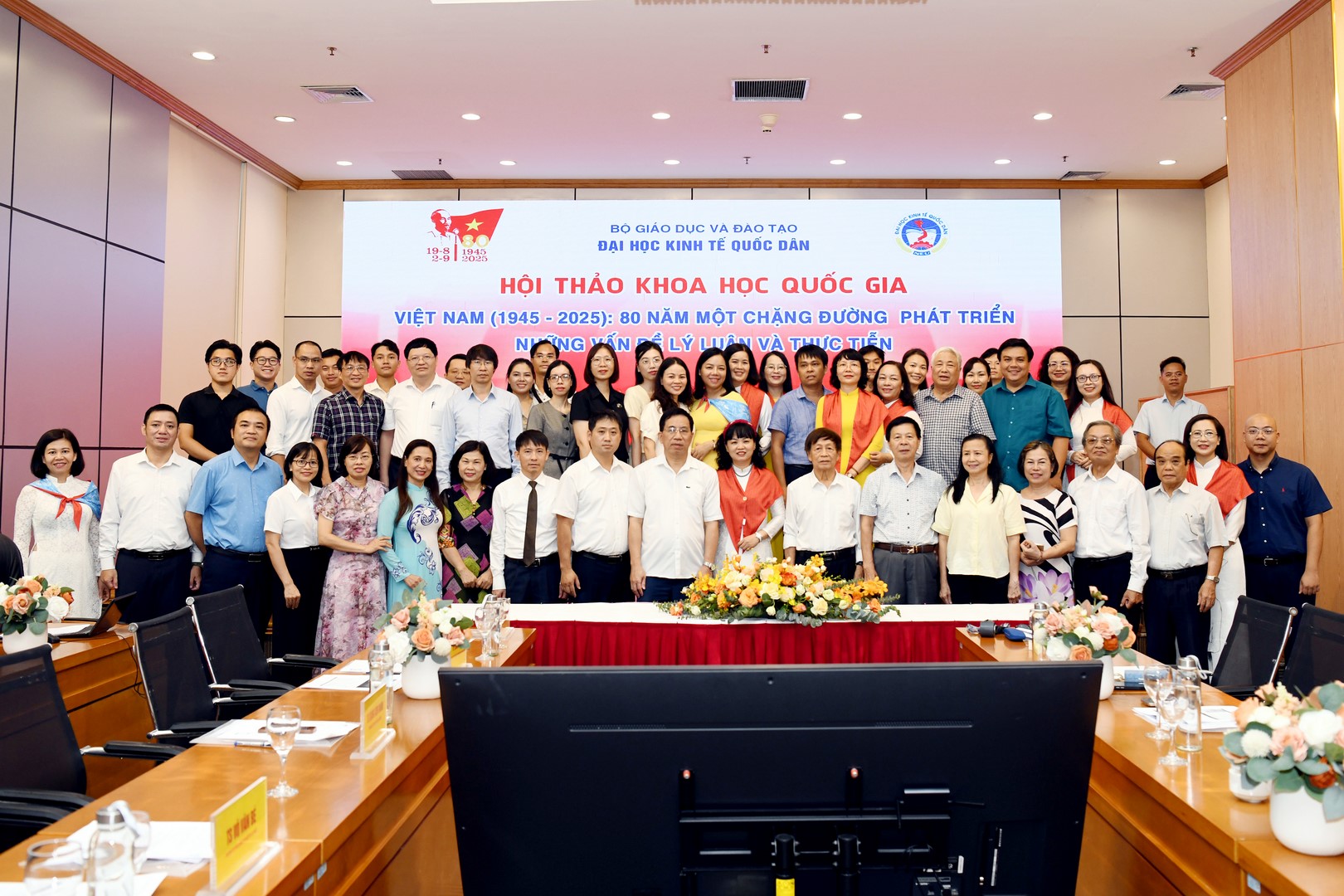
Conference delegates pose for a commemorative group photo
The conference focused on key topics including: the dialectical relationship between national independence and socialism in Vietnam’s practical experience; the socialist-oriented market economy in the context of globalization and digital transformation; the fundamental characteristics of socialism and the inevitability of the path toward socialism as demonstrated by 80 years of practical experience, along with issues arising in the new era; the leadership role of the Communist Party of Vietnam in national liberation and nation-building; and aspirations for peace, independence, freedom, and development in Ho Chi Minh Thought.
Selected photos from the conference:
Article and photos: Department of Communications
News agencies and media outlets reporting on the conference:
Nhan Dan: Discussing theoretical and practical issues in Vietnam’s 80-year journey
Vietnam News Agency: 80th anniversary of National Day: Building a streamlined, effective public administration that is close to the people
This is an automated translation. If you notice any errors, please contact the Department of Communications, National Economics University at phongtruyenthong@neu.edu.vn.