
Hung Kings Commemoration National Holiday (10th Day of the Third Lunar Month)
07/04/2025 2025-04-07 18:17Hung Kings Commemoration National Holiday (10th Day of the Third Lunar Month)
Hung Kings Commemoration National Holiday (10th Day of the Third Lunar Month)
Throughout the history of building and defending their country, generations of people in Vietnam have embraced the belief that the Hung Kings were the founding kings of the nation and the ancestors of the Vietnamese people. Hung Kings Commemoration Day is therefore an occasion for the entire nation to remember and express gratitude to the forebears who gave rise to its people, opened up its territory, and shaped the country.
Hung Kings Commemoration Day and Hung Temple are symbols deeply embedded in the sacred consciousness of every Vietnamese person. They are a focal point for spirituality, cultural identity, and the spirit of great national unity, providing the spiritual strength that enables the Vietnamese people to stand firm through every hardship and challenge, united in an unbreakable bond to overcome all natural disasters and enemies.
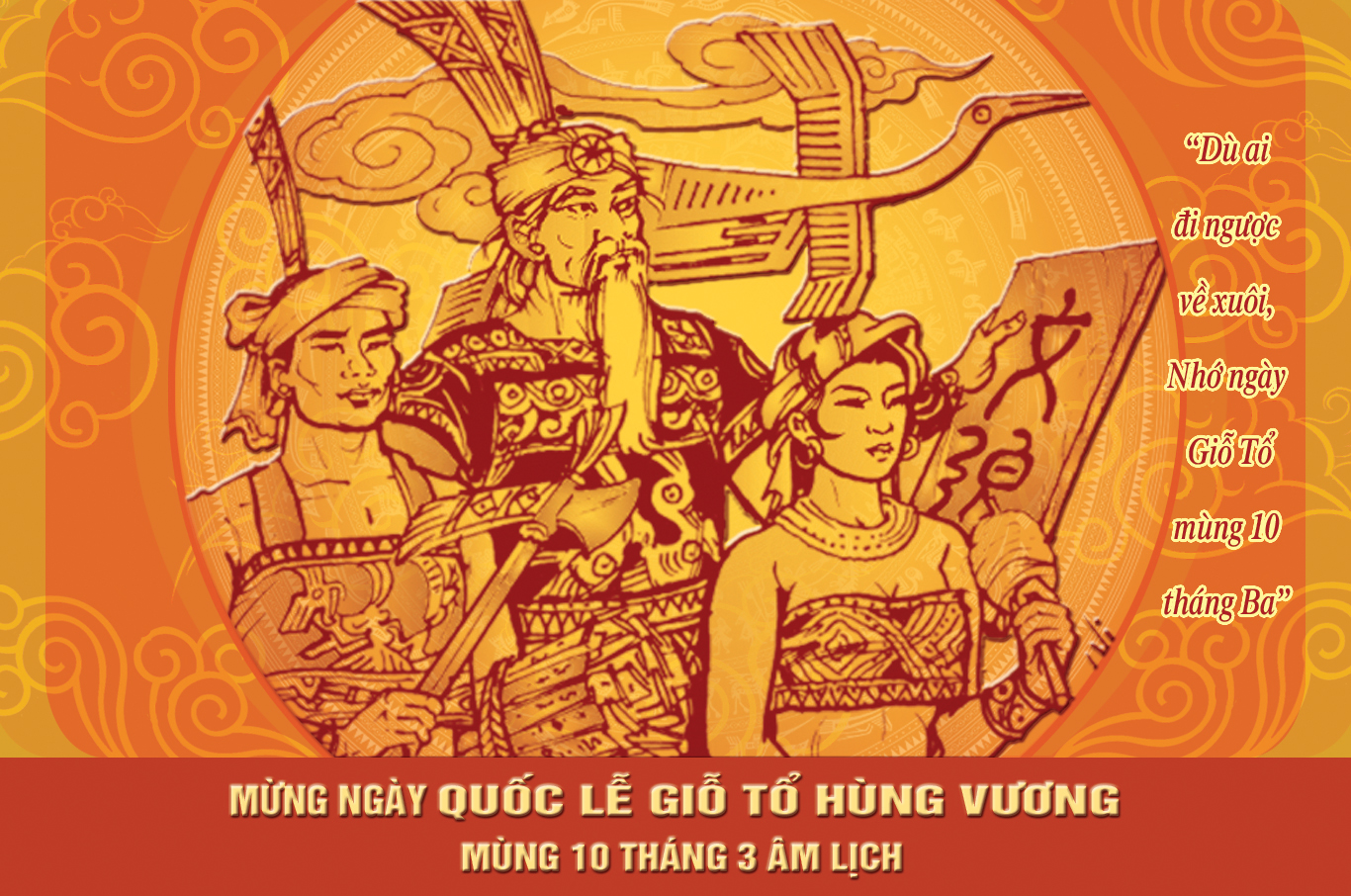
“Wherever you may travel, upstream or downstream,
Remember the ancestors’ commemoration on the tenth day of the third month.
Throughout the land, this verse will forever be passed down;
Our homeland remains our homeland through a thousand years.”
This folk verse, rich in affection and gratitude, has entered the hearts of Vietnamese people from generation to generation. For thousands of years, Hung Temple—the place of origin of the nation and the country—has remained a revered and sacred symbol that brings the Vietnamese people together and binds them to one another.
Hung Kings Commemoration Day takes place annually on the 10th day of the third lunar month at Hung Temple in Viet Tri, Phu Tho. The festival begins weeks beforehand with numerous folk cultural activities and concludes on the 10th day of the third lunar month with a palanquin procession and incense offerings at Thuong Temple.
Since ancient times, Hung Kings Commemoration Day has held a special place in the consciousness of Vietnamese people. A royal genealogy written during the Tran dynasty, copied in 1470 during the reign of King Le Thanh Tong and in 1601 during the reign of King Le Kinh Tong, authenticated with seals, and kept at Hung Temple states: “…From the Trieu, Dinh, Le, Ly, and Tran dynasties to our present dynasty, the Hong Duc era of the Later Le dynasty, all have continued to offer incense at the temple in Trung Nghia Village. The fields, land, and tax revenues set aside in earlier times for ritual offerings remain unchanged…”
Thus, it can be understood that, from the Later Le dynasty back through earlier dynasties, Hung Temple was managed by assigning local residents direct responsibility for its upkeep, repairs, worship, and the ancestors’ commemoration on the 10th day of the third lunar month. In return, they were exempt from taxes on 500 mau of farmland, the poll tax, corvee labor, and military service.
During the Nguyen dynasty, in the second year of the Khai Dinh reign (1917), Le Trung Ngoc, Governor of Phu Tho, petitioned the Ministry of Rites to designate the 10th day of the third lunar month each year as the day of national rites (a national ceremony and national ancestral commemoration). This is confirmed by the Hung Vuong tu khao stele, erected in the 15th year of the Bao Dai reign (1940) by Bui Ngoc Hoan, Vice Minister and Governor of Phu Tho Province, which also stands at Thuong Temple on Hung Mountain: “Previously, national rites were regularly held in the autumn. In the second year of the Khai Dinh reign (1917 in the solar calendar), Le Trung Ngoc, Governor of Phu Tho, submitted an Official Letter requesting that the Ministry of Rites designate the tenth day of the third month each year as the day of national rites, one day before the death anniversary of the 18th Hung King. The death anniversary itself (the 11th day of the third month) is observed by local residents.” From that point onward, the annual observance of Hung Kings Commemoration Day on the 10th day of the third lunar month was formally established by law.
Following the August Revolution (1945), the Party and State devoted considerable attention to Hung Temple, and State President Ho Chi Minh and other Party and State leaders visited to pay their respects. Continuing the fine traditions of their forebears, particularly the principle of “When drinking water, remember its source,” State President Ho Chi Minh signed State President’s Decree No. 22/SL – CTN dated February 18, 1946, shortly after the revolution’s victory. The decree granted civil servants leave on the 10th day of the third lunar month each year to help organize Hung Kings Commemoration activities and honor the nation’s roots.
On Hung Kings Commemoration Day in the Year of the Dog (1946)—the first year of the newly established Government—Huynh Thuc Khang, Acting State President, offered a map of Vietnam and a precious sword to inform the ancestors that the country had been invaded. He prayed for their blessings for national prosperity, the people’s well-being, and peace throughout the world, and for unity in defeating the invaders and safeguarding the country’s territorial integrity.
State President Ho Chi Minh also visited Hung Temple twice, on September 19, 1954, and August 19, 1962. It was here that he delivered his immortal words: “The Hung Kings built the country; together, we must defend it.” He also reminded people: “We must take care to protect the temple and plant more flowers and trees so that Hung Temple becomes ever more dignified and beautiful, a historical park for future generations to visit.”
In 1995, the Secretariat identified Hung Kings Commemoration Day as a major annual holiday in a notice. The culture, information, and sports sector coordinated with relevant sectors to organize a 10-day festival, from the first to the 10th day of the third lunar month.
On April 2, 2007, the National Assembly of the Socialist Republic of Vietnam approved amendments and additions to Article 73 of the Labor Code, granting workers a day off with full pay on Hung Kings Commemoration Day (the 10th day of the third lunar month). From that point onward, the 10th day of the third lunar month each year became a major holiday—a national holiday embodying the nation’s cultural identity.
The annual Hung Kings Commemoration Day is a shared celebration for all the people, a day when every heart beats as one and every gaze turns in the same direction, wherever people may live and work. On this day, people across the country also have the opportunity to participate in cultural activities that express their reverence and gratitude to the Hung Kings for founding the country and to the forebears who defended it for the people.
The nomination dossier submitted to UNESCO for recognition of the “Worship of the Hung Kings” as world cultural heritage clearly stated that the heritage’s value lies in expressing reverence for ancestors in keeping with the Vietnamese principle of “When drinking water, remember its source.” According to UNESCO experts, the “Worship of the Hung Kings” met the most important of the five criteria: the heritage possesses outstanding universal value and encourages a shared awareness among all peoples in promoting that value. Accordingly, on December 6, 2012, UNESCO officially recognized the “Worship of Hung Kings in Phu Tho,” a symbol of the spirit of great national unity and the Vietnamese moral tradition of “When drinking water, remember its source,” as Intangible Cultural Heritage of Humanity on the Representative List.
Hung Kings Commemoration Day and the Hung Temple Festival also provide an opportunity to teach the tradition of “When drinking water, remember its source” and profound gratitude to the Hung Kings for founding the country and to the forebears who steadfastly resisted foreign invaders to defend it. They are also an important occasion to introduce the world to an immensely valuable and unique heritage that has existed for thousands of years, taken root in people’s hearts and feelings, and become a moral tradition shared by people throughout the country and Vietnamese communities abroad. It is a day for the entire Party, armed forces, and people to pledge as one to forever remember State President Ho Chi Minh’s exhortation: “The Hung Kings built the country; together, we must defend it.”
This is an automated translation. If you notice any errors, please contact the Department of Communications, National Economics University at phongtruyenthong@neu.edu.vn.



