
Higher Education in the Double-Digit Growth Trajectory from the Perspective of NEU Vice President
20/07/2026 2026-07-28 13:28Higher Education in the Double-Digit Growth Trajectory from the Perspective of NEU Vice President
Higher Education in the Double-Digit Growth Trajectory from the Perspective of NEU Vice President
A strong higher education system is not one where all institutions are identical, but one where each educational institution has its own mission, strengths, and contributes to the common development goals of the nation.
Recently, the entire political system has focused on implementing nine strategic “pillar” resolutions issued by the Politburo. This is a comprehensive strategic framework shaping the future development of a strong, prosperous nation with happy citizens.
Vietnam considers double-digit growth a necessary requirement to realize the goal of becoming a developed, high-income country by 2045.
One of the solutions to achieve this goal, as emphasized multiple times by General Secretary and President To Lam, is that science and technology, innovation, and digital transformation must become the central drivers of the new growth model with institutions encouraging research and development. The innovation ecosystem, digital infrastructure, big data, artificial intelligence, and the close connection between the State, enterprises, research institutes, and universities are essential to commercialize research results and deeply participate in the global value chain and production value chain.
In the era of science and technology, innovation, and digital transformation, humans are not only the center but also the decisive factor in the success or failure of all development strategies. Therefore, education experts believe that high-quality human resources are a crucial lever for Vietnam to realize its goals of rapid and sustainable growth.
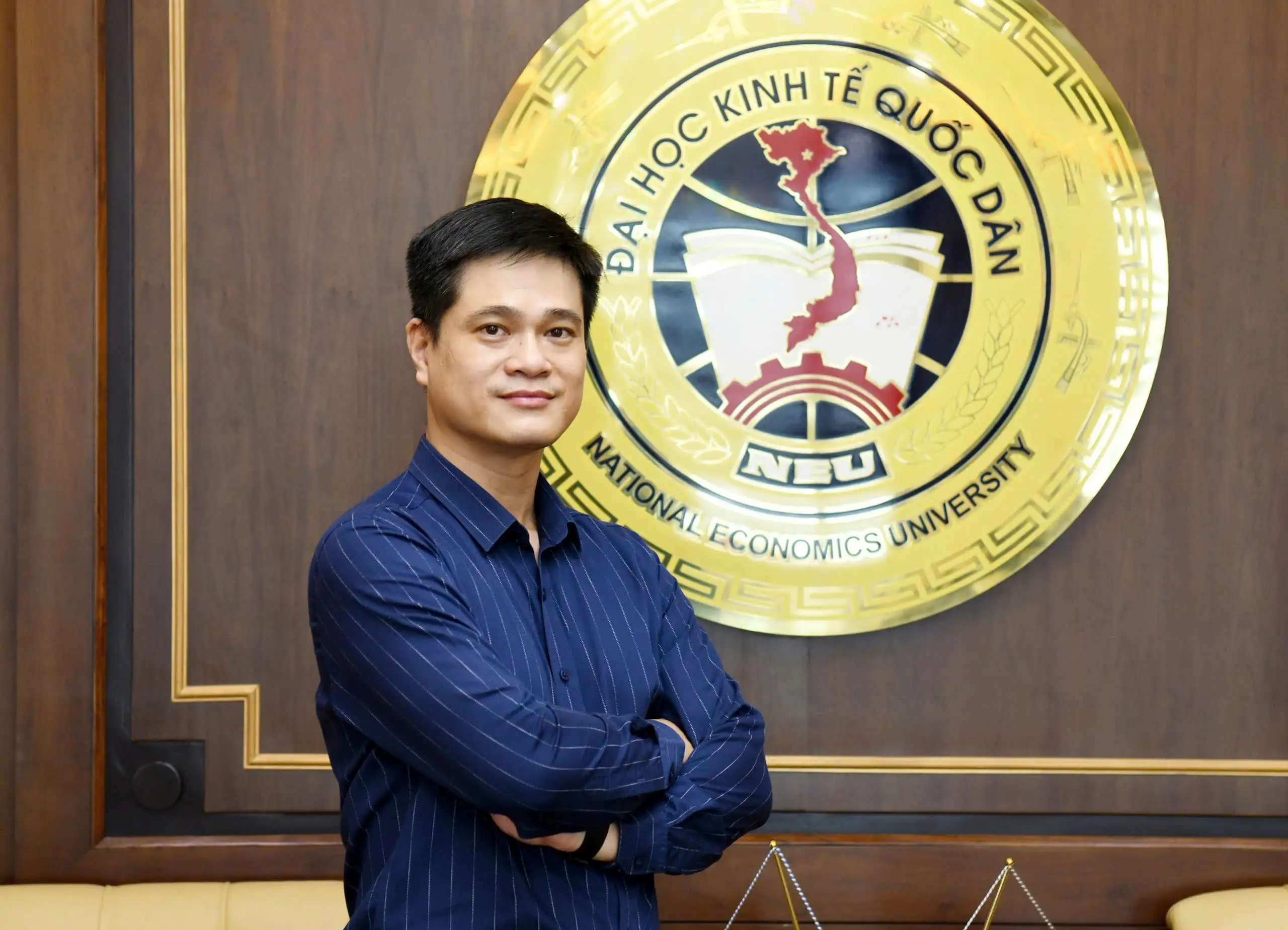
Prof. Dr. To Trung Thanh – an expert who has participated in policy advisory groups for the Ministry of Finance and the Macroeconomic Policy Advisory Group of the National Assembly’s Economic Committee, currently the Vice President of the National Economics University
To gain a deeper understanding of the role of higher education in the country’s double-digit growth trajectory, the Vietnam Education Online Magazine had a discussion with Prof. Dr. To Trung Thanh – an expert who has participated in policy advisory groups for the Ministry of Finance and the Macroeconomic Policy Advisory Group of the National Assembly’s Economic Committee, currently the Vice President of the National Economics University.
Interviewer: It can be seen that to achieve rapid and sustainable growth, high-quality human resources are essential. To have high-quality human resources, investment in higher education, vocational education, science and technology, and innovation is necessary.
How does Prof. To Trung Thanh evaluate the particularly important role of higher education in achieving the goal of developing high-quality human resources and realizing the country’s “double-digit” growth target?
Prof. To Trung Thanh: Looking at the development history of countries worldwide, no nation has been able to maintain high and sustainable growth rates without building a strong education system. While natural resources can offer a head start, it is education that shapes an economy’s long-term competitiveness and sustainable development prospects.
Therefore, as Vietnam sets the goal of double-digit economic growth in the coming period, the most crucial task is to build high-quality human resources, promote science, technology, innovation, and enhance labor productivity. These are the fundamental foundations for rapid and sustainable growth.

Students of the National Economics University
Modern growth theories all indicate that as an economy develops to a certain level, traditional factors such as capital and labor gradually diminish in role, while knowledge, technology, innovation, and the quality of human resources become the decisive driving forces. In other words, a nation’s long-term growth rate heavily depends on its ability to create, disseminate, and apply knowledge. Therefore, education is not merely a public service provider but a creator of the most crucial development resources for the nation.
Thus, in my opinion, higher education in the current period needs to fulfill three missions simultaneously.
First, higher education must cultivate high-quality talent capable of adapting to and driving development. In the age of artificial intelligence and digital transformation, knowledge is more accessible than ever. What increasingly differentiates graduates is no longer the volume of knowledge they possess, but their ability to think critically, innovate, solve complex problems, work across disciplines, adapt to change, and embrace lifelong learning. These are the core competencies that higher education must prioritize to enable learners not merely to respond to change, but to lead it.
Second, universities must become centers of knowledge creation and innovation. Today’s universities not only disseminate knowledge but also create new knowledge, develop technological solutions, provide scientific arguments for economic-social development policymaking, and collaborate with businesses to solve practical problems. An economy that wants to increase productivity cannot rely solely on expanding investment but must depend on continuous innovation. To achieve this, universities must become strong research centers, where new ideas, new technologies, and new development models are generated.
Third, universities need to become the nucleus of the national innovation ecosystem. In the modern development model, universities no longer operate independently but must closely connect with businesses and the State. This linkage shortens the distance from research to application, from idea to product, and from knowledge to economic value. A successful university is not only evaluated by the number of graduates or scientific publications but also by its substantial contributions to the country’s development.
Reporter: According to statistics from the General Statistics Office and the Ministry of Finance, budget expenditure for the entire education sector from 2004-2022 fluctuated around 17-19% of total expenditure, equivalent to 4.5-5.5% of GDP. However, expenditure on higher education – the key sector for creating high-quality human resources – has accounted for less than 0.3% of GDP for many consecutive years. Despite limited investment resources, Vietnamese higher education has still managed to train a large workforce for the economy at relatively low costs compared to many countries.
This indicates that if invested properly and with the right focus, higher education can generate significant developmental effectiveness, doesn’t it, Professor?
Prof. Dr. To Trung Thanh: In my view, the more important issue is not simply that public investment in higher education remains inadequate, but how we perceive such investment. Higher education should be regarded as a strategic investment in a nation’s long-term competitiveness. It delivers one of the highest social returns of any form of public investment, as its outcomes extend far beyond university degrees. They include a highly skilled workforce, scientific research, technological innovation, high-growth startups, evidence-based policymaking, stronger labor productivity, and ultimately, a more competitive economy.
In recent years, despite limited resources, Vietnam’s higher education has achieved many commendable results. The scale of academic programs continues to expand; the quality of education is gradually improving; the number of international publications is rapidly increasing; many universities have gradually affirmed their positions in regional and international rankings; international collaboration activities are increasingly developing; and many research outcomes have been transferred into practical management and production. This demonstrates that Vietnam’s intellectual community and higher education institutions have great potential if systematically invested in and provided with development opportunities.

The Library Space of the National Economics University
However, the issue is not simply about increasing investment levels, but more importantly, about innovating the investment mindset. Given the limited resources, we need to shift from an average allocation mindset to a focused, selective investment approach based on output effectiveness.
Firstly, investment should prioritize fields that have the potential to create significant ripple effects on the country’s growth model transformation, such as artificial intelligence, semiconductors, digital technology, green technology, digital economy, finance, management, and sectors directly serving the national development strategy.
Second, greater investment should be directed toward building world-class research universities and centers of research excellence. International experience shows that virtually every country with a strong innovation ecosystem is anchored by leading research universities that serve as the nucleus of its science, technology, and innovation system. These institutions not only educate top talent but also generate new knowledge, pioneer breakthrough technologies, and provide evidence-based policy solutions that contribute directly to national development.
Third, investment must be accompanied by institutional autonomy and robust accountability. Financial resources can deliver their full impact only when universities have the autonomy to govern effectively, allocate resources efficiently, and pursue their long-term strategic priorities, while remaining accountable for the quality of education, research outcomes, and their broader contributions to society. The effectiveness of investment in higher education should not be measured solely by enrollment numbers or the proliferation of academic programs. Rather, it should be assessed by the quality of graduates, research excellence, knowledge transfer, the ability to attract external funding and partnerships, and, ultimately, the institution’s tangible contribution to economic and social development.
Fourthly, the development of higher education cannot rely solely on the state budget. In the new context, mechanisms need to be established to strongly mobilize the participation of enterprises, development funds, international organizations, alumni, and the entire society. The state plays a guiding and facilitating role, but sustainable development of higher education must be built on the foundation of effectively mobilizing and utilizing the combined resources of society.
Interviewer: According to the Professor’s assessment, how does focusing investment on key higher education institutions by sector, field, and region, while building some universities with strong research capabilities that can lead the system, gradually forming elite universities with regional and international standing, help higher education take a step ahead in preparing high-quality human resources and capturing trends in training new professions?
Prof. Dr. To Trung Thanh: I believe this is a strategically significant direction for the development of Vietnam’s higher education in the coming period. In the context of increasingly fierce global competition and unprecedented scientific and technological advancements, we must build strong centers of knowledge, research, and innovation to lead the development of the entire system and contribute directly to national development.
It should be recognized that the ultimate goal of building key or elite universities is to create “locomotives” capable of leading the development of the higher education system towards modernity, integration, and innovation. A strong higher education system is not one where every institution is the same, but one where each educational institution has its own mission, strengths, and collectively contributes to the country’s overall development goals.
In the context of the Fourth Industrial Revolution profoundly changing the structure of the economy and labor market, the role of key universities becomes even more important. Artificial intelligence, big data, semiconductor technology, green technology, digital economy, and circular economy are opening up entirely new development fields. Meanwhile, many traditional professions are being significantly restructured under the impact of technology and AI.
This requires higher education systems not only to meet today’s workforce needs but also to anticipate and prepare the talent required for tomorrow. If businesses recruit for the demands of today, universities must educate for the needs of the next five to ten years. Achieving this requires strong research capabilities, enabling universities to identify emerging technological and economic trends, anticipate shifts in the labor market, and equip graduates with the skills needed to thrive in a rapidly evolving economy.

The Library of National Economics University
Furthermore, in the modern development model, universities are not only places for training human resources but also hubs for connecting knowledge with the market, linking research with production, and aligning ideas with investment resources. Many of the world’s leading technology corporations, billion-dollar startups, and groundbreaking technologies have originated from research universities.
Therefore, investing in the development of key universities, strong research universities, and gradually forming elite universities is not merely an investment in education. It is an investment in national competitiveness, innovative capacity, and the future development of the country in the new era.
Interviewer: In the orientation for educational development tasks in the coming period, General Secretary and State President To Lam emphasized the shift from “education management” to “education development governance”.
According to you, how will higher education create breakthroughs to meet the demands for rapid, sustainable, autonomous, and resilient development in the new era of the country?
Prof. Dr. To Trung Thanh: The orientation set by General Secretary and State President To Lam requires a fundamental shift in the mindset of educational governance.
Whereas traditional education administration is primarily concerned with ensuring regulatory compliance, controlling processes, and enforcing rules, development-oriented governance of higher education focuses on creating value, empowering institutional autonomy, fostering innovation, and holding institutions accountable for outcomes and their contribution to the country’s economic and social development.
This shift in mindset will create three breakthroughs in higher education.
First, higher education must shift from a supply-driven model to one that is aligned with the country’s long-term development priorities and evolving labor market needs. Universities should no longer ask only, “What are we capable of teaching?” but, more importantly, “What talent will the country need in the next five, ten, or even twenty years?” Answering that question requires universities to strengthen their capacity to forecast workforce demand, design agile and future-oriented curricula, and forge close partnerships with industry, particularly in strategic and emerging technology sectors.
Second, higher education must evolve from a model centered on the transmission of knowledge to one focused on the creation of knowledge. Under a development-oriented governance model, universities are not merely providers of education; they are engines of research, innovation, and technology transfer. This vision is also at the heart of Resolution No. 57-NQ/TW, which identifies science, technology, innovation, and digital transformation as key drivers of the country’s future development.
Third, higher education governance must shift from a process-based approach to one centered on performance and accountability. As universities are granted genuine institutional autonomy, they must also be held accountable for the quality of education they provide, the impact of their research, their capacity for innovation, their contribution to economic and social development, and their standing in the global academic community. Such a governance model creates the incentives for healthy competition and drives institutions to continuously improve their performance and quality.
Education development governance is essentially the governance of a knowledge ecosystem. The state does not replace universities but creates institutions for them to maximize autonomy and compete through quality, innovation, and contributions to national development.
When universities fulfill their threefold mission on the foundation of modern governance, higher education will become one of the most crucial drivers for Vietnam’s rapid and sustainable development in the new era.
Reporter: Sincere thanks to Professor To Trung Thanh.
Source: Vietnam Education Magazine