
Launch of the “World Social Protection Report 2024–2026”
30/10/2024 2024-10-30 20:34Launch of the “World Social Protection Report 2024–2026”
Launch of the “World Social Protection Report 2024–2026”
This morning (October 30, 2024), National Economics University (NEU), in collaboration with the International Labour Organization (ILO), held a presentation of the “World Social Protection Report 2024–2026.” This is an important study that Vietnam can draw on to implement social protection more effectively in the new context.

A view of the event
External guests attending the event included Seán Farrell, Deputy Ambassador, Embassy of Ireland in Vietnam; Ingrid Christensen, Country Director, ILO Office in Vietnam; Andre Gama, Social Protection Program Manager, ILO Vietnam; Nguyen Hai Dat, Social Protection Program Coordinator, ILO Vietnam; Assoc. Prof. Dr. Bui Van Huyen, Director of the Institute of Economics, Ho Chi Minh National Academy of Politics; Assoc. Prof. Dr. Nguyen Chien Thang, Director of the Institute for European Studies; Nguyen Quang Huy, Deputy Director-General in charge of the Department of General Economic Affairs, Central Economic Commission; Tran Kim Anh, Deputy Director-General of the Department of General Economic Affairs, Central Economic Commission; Nguyen Mau Quyet, Deputy Director-General of the Department of Social Affairs, Central Economic Commission.
Representing NEU were Prof. Dr. Pham Hong Chuong, President of NEU; Assoc. Prof. Dr. Bui Duc Tho, Secretary of the Party Committee and Chair of the University Council; Assoc. Prof. Dr. Bui Huy Nhuong, Vice President of NEU; Assoc. Prof. Dr. Nguyen Thanh Hieu, Vice President of NEU; Dr. Nguyen Huu Dong, Deputy Secretary of the Party Committee and Chair of the NEU Trade Union; Prof. Dr. Tran Tho Dat, Chair of the Science and Training Council; and Prof. Dr. To Trung Thanh, Head of the Department of Research Management and standing member of the Organizing Committee. Also attending were representatives of the leadership of schools, departments, faculties, institutes and centers; members of the Science and Training Council; leaders of units and divisions; and the University’s faculty, staff and students.
The presentation aimed to disseminate the key messages of the World Social Protection Report 2024–2026, as well as the contents of the Asia-Pacific regional companion report, to a wide range of stakeholders in Vietnam, including Party bodies, the National Assembly, the Government, social organizations, organizations representing workers and employers, development partners, United Nations agencies, universities, research institutes, localities and businesses.

Prof. Dr. Pham Hong Chuong, President of NEU, delivers remarks.
Speaking at the presentation, Prof. Dr. Pham Hong Chuong, President of NEU, said that social protection goals are among the key goals a country must achieve to develop sustainably. Social protection systems play an important role in ensuring sustainable development, promoting social justice and realizing the right to social protection for all. Social protection policies have therefore become, and continue to be, essential elements of national development strategies to reduce poverty and improve household incomes and living standards, while also promoting economic restructuring and the development of decent work.
Prof. Pham Hong Chuong also noted that, in recent years, the Government of Vietnam has made further important progress in laying the groundwork for gradually expanding social protection coverage. This is reflected in Resolution 28-NQ/TW (2018) on social insurance policy reform; Resolution 42-NQ/TW (2023) on social policy renewal; the revision of the Law on Social Insurance (2024); and the ongoing revisions of the Law on Health Insurance and the Law on Employment. These changes bring Vietnam closer to achieving the Sustainable Development Goals (SDGs), in line with International Labor Standards (ILS) and international best practices.
However, many challenges remain in extending social protection to all, such as a large informal labor market and rapid population aging in a middle-income context. In particular, climate change has emerged as a major challenge in recent years. Vietnam is among the countries most affected by climate change. This affects us all and is the most serious threat to social justice today. This was emphasized in the ILO’s World Social Protection Report 2024–2026.
According to Prof. Pham Hong Chuong, universal social protection is the foremost tool currently available to address these challenges and help ensure that the climate crisis does not exacerbate inequality or affect economic growth and sustainable development. To further advance universal social protection in Vietnam, social protection policies must be renewed to ensure that the policy system aligns with International Labor Standards (ILS) and international best practices. The focus must be on a comprehensive and integrated approach to ensure that Vietnam’s social protection system can address current challenges arising from digital transformation, climate change and population aging, leaving no one behind. Balanced investment in both economic growth and new social policies will help Vietnam achieve its goal of becoming an upper-middle-income country by 2030 and attaining universal social protection coverage.

Seán Farrell, Deputy Ambassador, Embassy of Ireland in Vietnam, delivers remarks.
According to Seán Farrell, Deputy Ambassador, Embassy of Ireland in Vietnam, as increasing numbers of people are left behind by the effects of climate change, social protection is an effective tool for reducing poverty and helping vulnerable groups withstand climate change and natural disasters. Social protection systems are changing to enable greater participation by people living in poverty, and the Embassy of Ireland shares the ILO’s vision of strengthening social protection systems and achieving universal social protection coverage.

Ingrid Christensen, Country Director, ILO Office in Vietnam, delivers remarks.
Ingrid Christensen, Country Director, ILO Office in Vietnam, said that more than half of the world’s population (52.4%) is covered by social protection, while the figure for Asia and the Pacific is 53.6%. However, a very large gap remains, with as many as 3.8 billion people worldwide lacking this coverage.
Accordingly, the ILO estimates that the world needs an additional USD 1,400 billion, or 3.3% of GDP, to provide social protection coverage. Of this amount, Asia and the Pacific needs USD 554 billion, or 2.0% of GDP.
Regarding Vietnam, the ILO Vietnam Country Director said that social protection has been a priority for the country in recent years. Vietnam has demonstrated very strong commitments to social protection through the adoption of Resolution 42-NQ/TW (2023) on social policy renewal and the revised Law on Social Insurance (2024), as well as the ongoing revisions of the Law on Health Insurance and the Law on Employment. These changes bring Vietnam closer to achieving the Sustainable Development Goals (SDGs), in line with International Labor Standards (ILS) and international best practices.
Statistics show that Vietnam’s budget spending on social protection as a share of GDP has gradually increased over the years, from 2.85% in 2005 to 4.14% in 2010, 4.67% in 2011, approximately 6.7% in 2021 and approximately 7% in 2023…
However, experts note that major global trends such as climate change, demographic trends and technological development continue to present new challenges for societies and policymakers, and Vietnam is no exception.
“In particular, the recent typhoons Yagi and Trami have highlighted Vietnam’s vulnerability to climate change and extreme weather events,” Ingrid Christensen emphasized.

Andre Gama, Social Protection Program Manager, ILO Vietnam, delivers remarks.
Also speaking at the presentation, Andre Gama, Social Protection Program Manager, ILO Vietnam, said that social protection makes an important contribution to both climate change adaptation and mitigation. Social protection helps protect people’s incomes, health and employment, as well as businesses, from climate shocks and the adverse effects of climate policies. Policy action is therefore needed to strengthen social protection systems and adapt to new realities, particularly in the countries and territories most vulnerable to climate change.
The world is currently on two very different and diverging social protection trajectories: high-income countries are moving closer to universal coverage (reaching 85.9%), while upper-middle-income countries (71.2%) and lower-middle-income countries (32.4%) are making major strides in closing coverage gaps. Meanwhile, coverage in low-income countries (9.7%) has barely increased since 2015.
Proposing several social protection policies, Andre Gama said that national social protection systems need to be strengthened to achieve universal social protection. This includes expanding coverage to workers in all forms of employment, improving benefit levels, and ensuring at least a basic level of social protection for everyone. In addition, sustainable and equitable financing for social protection should be secured by mobilizing domestic resources through taxes and social insurance contributions, and mobilizing international support where necessary…

Nguyen Hai Dat, Program Coordinator for Social Protection at ILO Vietnam, presents the paper “Social Protection in Asia and the Pacific.”

Prof. Dr. Giang Thanh Long, Senior Lecturer at National Economics University (NEU), presents the paper “Social Protection in Vietnam: Challenges and Policy Options toward Universal Social Protection by 2030.”
Prof. Dr. Giang Thanh Long, Senior Lecturer at NEU, also said that the high rate of population aging poses a major challenge to Vietnam’s social protection system.
According to calculations based on the 2019 Population and Housing Census and the General Statistics Office’s population projections for 2019-2069, Vietnam’s older population (aged 60 and above) rises sharply from 11.4 million, or 11.86% of the population, in 2019 to 20.2 million, or 18.71%, in 2034, and then to 28.6 million, or 24.88%.
The Asian Development Bank’s (ADB) recently released survey on “Healthy Aging in Asia” assessed Vietnam as belonging to the group of economies with universal health coverage (UHC) and high participation rates. Vietnam also scores above average on the index, a standardized score measuring the program’s effectiveness in meeting people’s health care needs throughout their lives. In particular, Vietnam is among the countries with the highest rates of meeting older people’s needs for access to health care services through universal health coverage.
According to experts, despite notable progress and achievements in recent decades, Vietnam still faces many challenges. Stronger social protection policy reform is imperative. It is also necessary for Vietnam’s economic development and for ensuring that the gains from its development are distributed fairly and reasonably, leaving no one behind.
Vietnam must therefore continue to strengthen its commitment to and investment in the social protection system to continue capitalizing on its outstanding economic progress.
Experts also said that Vietnam is working toward universal social protection and should stipulate a minimum budget allocation for social protection to achieve this goal. Accordingly, the social protection budget could account for 6–10% of GDP, with increased state budget spending on voluntary social insurance policies so that informal workers can receive the full range of benefits available under compulsory social insurance.
In practice, informal-sector workers currently show little interest in participating in voluntary social insurance because their incomes are precarious and unstable. In addition, the deeply ingrained belief that people should “rely on their parents when young and their children when old” persists. As a result, a culture of providing for one’s own social protection through contributions and savings while young to receive pensions and insurance benefits in old age has yet to develop.
Moreover, current state subsidies for contributions have not provided sufficient impetus to encourage participation in voluntary social insurance. Meanwhile, the long contribution period required to qualify for a pension reduces the appeal of voluntary social insurance and discourages some people. Furthermore, adding social insurance benefits beyond retirement and survivor benefits requires substantial support from the state budget, which is difficult under current conditions given budget constraints.
Prof. Dr. Giang Thanh Long said that major trends are gathering momentum and pose many challenges to Vietnam’s social protection system. The first priority is to unify and harmonize social protection policies and benefits. Currently, policies are fragmented and governed by various legal documents, such as the Law on Social Insurance, the Law on Employment, the Law on the Elderly, and the Law on Natural Disaster Prevention and Control…
Earlier, Prof. Dr. Pham Hong Chuong, President of NEU, and representatives of the University’s leadership welcomed and held a working meeting with Ingrid Christensen, Country Director of the ILO Office in Vietnam, and her delegation.
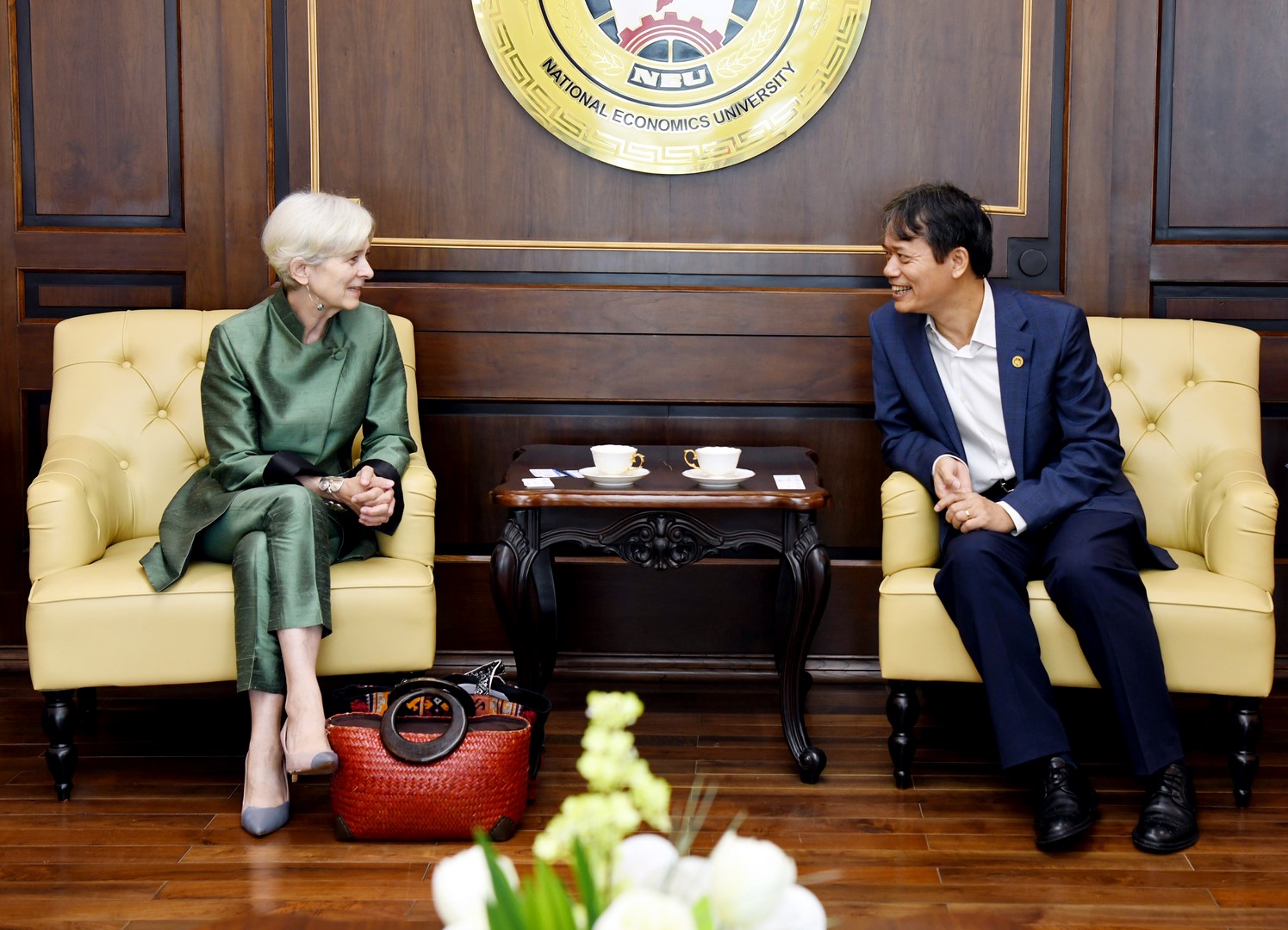

Prof. Dr. Pham Hong Chuong, President of NEU, and representatives of the University’s leadership welcome and hold a working meeting with Ingrid Christensen, Country Director of the ILO Office, and her delegation.
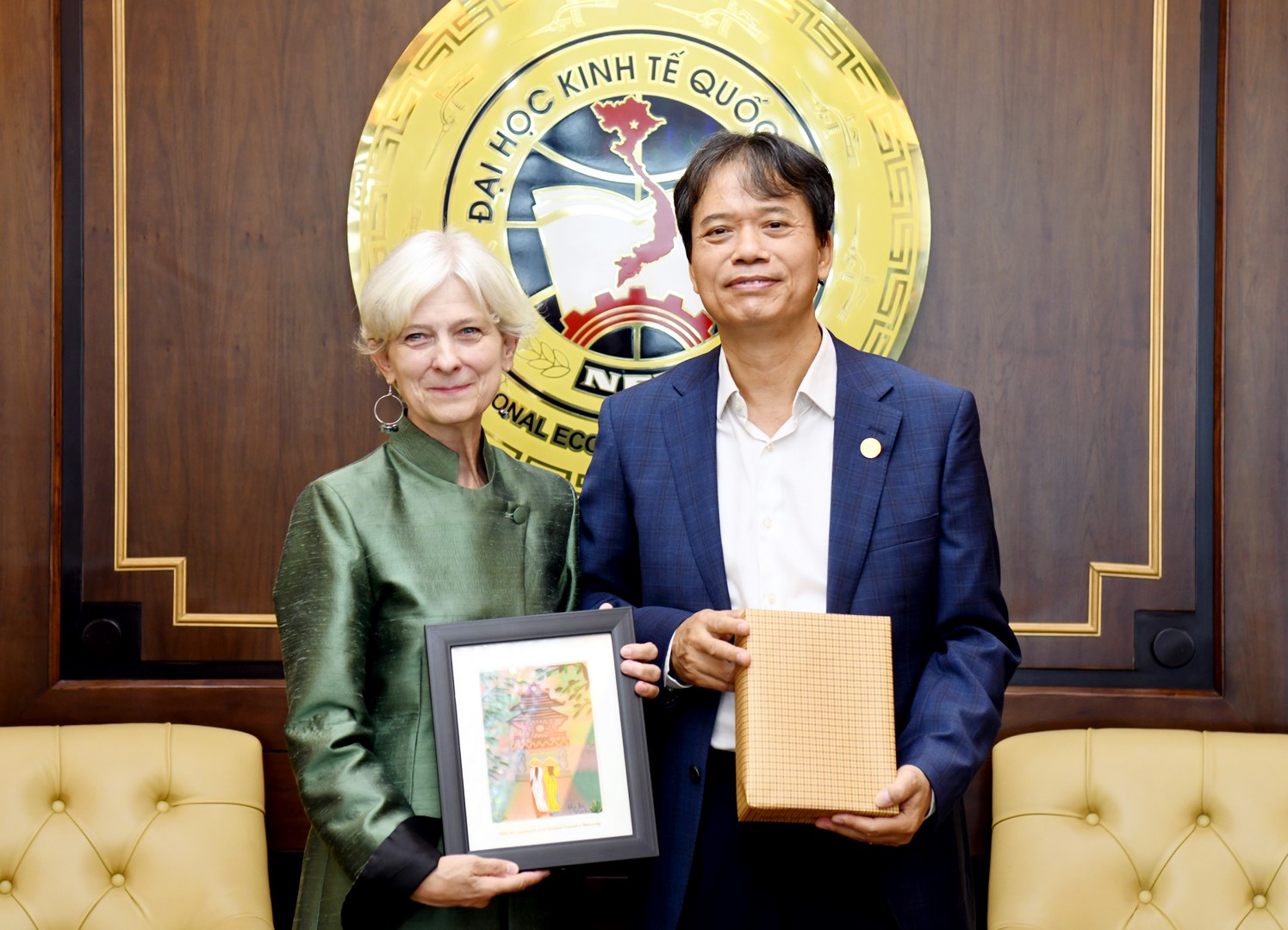

Prof. Dr. Pham Hong Chuong, President of NEU, Ingrid Christensen, Country Director of the ILO Office, and participating delegates exchange gifts and pose for a commemorative photo.
Some photos from the presentation:


Article and photos: Department of Communications
Media coverage of the presentation:
Nhan Dan: Balanced investment to achieve universal social protection coverage
Vneconomy: Closing the social protection financing gap
Lao Dong: Promoting universal social protection, leaving no one behind
Vietnam Financial Times: Social protection makes an important contribution to climate change adaptation and mitigation
Vietnam News Agency: Innovating social protection policies to expand universal coverage
Government: Balanced investment in the economy and social protection will help Vietnam achieve sustainability goals
Dai Bieu Nhan Dan: More than half the world’s population is covered by social protection
Communist Party of Vietnam Online Newspaper: Introducing the “World Social Protection Report 2024–2026”
Vietnam Plus: Innovating social protection policies to expand universal coverage
Dai Doan Ket: Budget spending on social protection could account for up to 10%
Business Forum: Climate change “threatens” social equity
Customs: Balanced investment in economic growth and social protection
Banking Times: Reforming social protection policies to leave no one behind
Cong Luan: Experts: Stronger social protection policy reform is imperative
VOV: Innovating social protection policies to expand universal coverage
Investment Newspaper: Prioritizing balanced investment in economic growth and social policies
Industry and Trade Newspaper: Social protection: A tool to help combat climate change
Corporate Finance Magazine: Focusing on a comprehensive approach and balanced investment
Vnbusiness: Population aging challenges Vietnam’s social protection system
Social Insurance Magazine: Reforming social protection policies to “leave no one behind”
This is an automated translation. If you notice any errors, please contact the Department of Communications, National Economics University at phongtruyenthong@neu.edu.vn.