
Cafef.vn: Prof. Dr. Tran Tho Dat: The Economic Potential of Generative AI
19/01/2024 2024-01-19 8:48Cafef.vn: Prof. Dr. Tran Tho Dat: The Economic Potential of Generative AI
Cafef.vn: Prof. Dr. Tran Tho Dat: The Economic Potential of Generative AI
In Just One Year Since ChatGPT Emerged, the World Has Witnessed Breakthrough Changes, and Numerous Estimates Suggest That Generative AI Could Deliver Trillions of Dollars in Value to the Global Economy Each Year.
With its increasingly transformative positive effects, AI is a technology with the potential to change almost every aspect of human life, from how people work and communicate to how they respond to and solve complex problems. AI is having profound impacts, driving innovation across industries and creating new applications for businesses and consumers, thereby fueling economic growth. In just one year since ChatGPT emerged, the world has witnessed breakthrough changes, and numerous estimates suggest that generative AI could deliver trillions of dollars in value to the global economy each year. As businesses move urgently to adapt to and deploy this technology, understanding the potential of generative AI will deliver value to society and the economy by informing important decisions.

Part 1: The economic impact of generative AI
Expecting AI to produce measurable macroeconomic effects, economists at Goldman Sachs have raised their 10-year forecast for global gross domestic product (GDP) to reflect the economic benefits, particularly productivity effects, of integrating AI. Specifically, these economists estimate that AI could add 1.5 percentage points to annual U.S. productivity growth if it is widely adopted over the next decade.
Following recent breakthrough advances, generative AI is rapidly becoming one of the fastest-growing platforms ever, marking a breakthrough in artificial intelligence. Generative AI clearly is having, and will continue to have, an increasing economic and social impact on communities, yet most people do not fully understand its effects because of its rapid development. As companies continue to advance the technology, analysts are working to determine the economic impact of generative AI. Like traditional (or non-generative) AI, generative AI has the potential to improve productivity by solving problems beyond human capabilities, helping people work more efficiently and/or automating functions performed by humans, and much more. In many cases, generative AI is replacing traditional AI models, positioning it to deliver new business value and create the next wave of workforce productivity growth.
Generative artificial intelligence is a breakthrough in artificial intelligence. As businesses move urgently to adapt to and deploy this technology, understanding the potential of this new AI technology will deliver value to society and the economy by informing important decisions. Understanding its economic potential requires an understanding of the breakthroughs that have enabled the rise of generative AI and economic impacts that previously took decades to achieve. Given its broad range of applications and transformative pace, forecasts of the value of generative AI vary widely, from hundreds of billions to trillions of dollars. Although the only consensus so far is that the economic impact of generative AI could be enormous, just how large it will be depends on how analysts “measure” it.
At the lower end and within a narrow scope, Statista Market Insights estimates the size of the generative AI market at USD 44.89 billion in 2023, rising to USD 207 billion in 2030. Statista assessed growth potential across multiple areas, including personalized user experiences, creative content generation, and personalized medical treatment.
Bloomberg Intelligence recently released a report on the AI economy, finding that the generative AI market is poised to grow at a compound annual rate of 42%, from USD 40 billion in 2022 to USD 1.3 trillion over the next 10 years. The report identifies the largest drivers of incremental revenue as generative AI infrastructure as a service (USD 247 billion by 2032), used to train large language models, followed by technology-driven digital advertising (USD 192 billion) and specialized AI assistant software (USD 192 billion). On the hardware side, revenue growth will come from AI servers (USD 132 billion), AI storage (USD 93 billion), computer vision AI products (USD 61 billion), and conversational AI devices (USD 108 billion).
Goldman economists estimate that generative AI could automate approximately 25% of work tasks in major developed markets such as the United States. They also predict that greater automation will help save labor costs and free up workers’ time for new tasks. An MIT study in the summer of 2022 focusing on tasks such as writing cover letters, emails, and cost-benefit analyses demonstrated the influence of the new technology on human work. The results, as measured by independent evaluators, showed that using ChatGPT reduced task completion time by 40% and increased output quality by 18%.
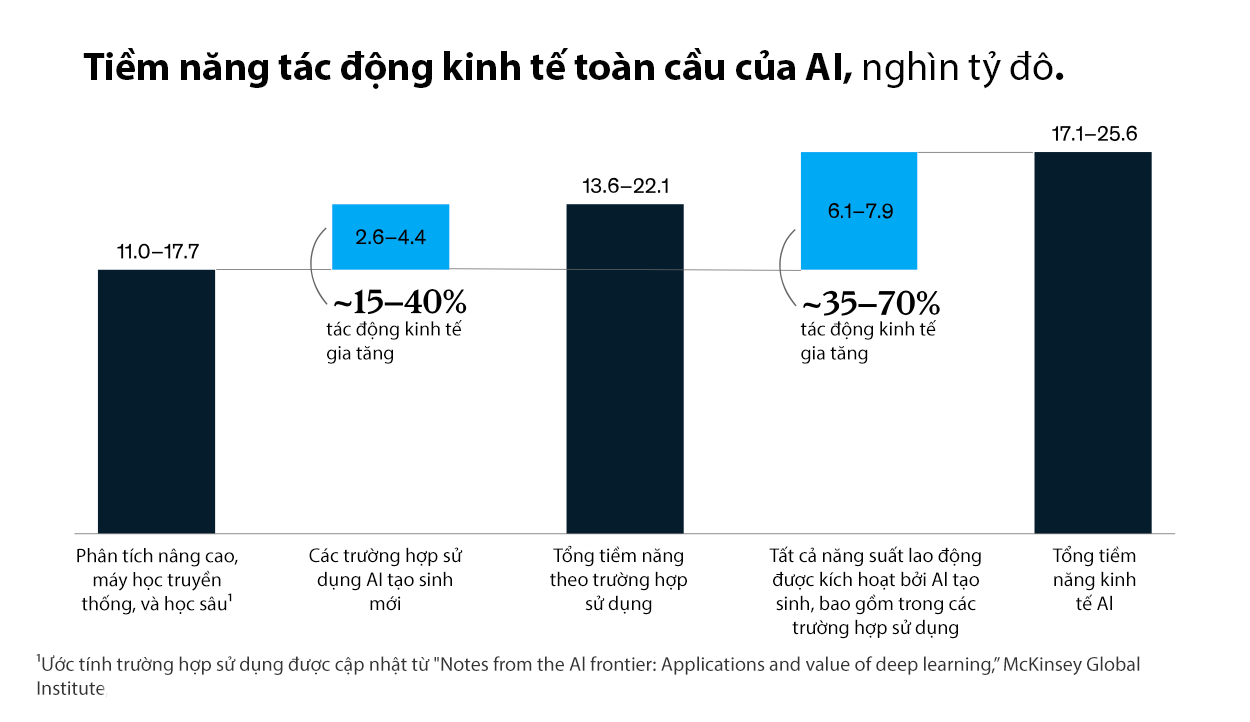
McKinsey & Company analyzed 63 use cases in which generative AI addresses specific problems across 16 business functions and determined that generative AI could deliver substantial economic benefits. The findings of this latest study assessing the impact of the generative AI era show that this AI could transform roles and business practices and improve performance in areas such as sales, marketing, customer service, and software development. In the process, AI could deliver between USD 2.6 trillion and USD 4.4 trillion in value annually; by comparison, the United Kingdom’s GDP in 2021 was equivalent to USD 3.1 trillion. When the impact of all areas of AI (generative and non-generative) is included, this value would increase by 15–40% and could double if generative AI were integrated into applications to perform tasks beyond the use cases studied. This means that 15–40% would be added to the USD 11–17.7 trillion in economic value that non-generative AI could generate (compared with the earlier 2017 estimate that AI could generate USD 9.5–15.4 trillion).
Generative AI affects most business functions, but some stand out when the technology’s impact is measured as a share of functional costs. McKinsey’s analyses indicate that, among 16 business functions, four—customer service operations, marketing and sales, software engineering, and research and development—account for as much as 75% of the total annual value of generative AI use cases.
Specifically, generative AI is driven by customer operations (for example, chatbots and agent support), marketing and sales (media development and personalized communications), software engineering (code development and maintenance), and R&D (design, simulation, and testing) across all industries. This value is created as AI enables specific new business functions that the technology can address with measurable results. Examples include using generative AI to support customer interactions, create content for sales and marketing, or write computer code based on natural-language requests, among many other tasks.
Generative AI also has a significant impact on other industries, with banking, high technology, and life sciences among those most affected. For example, based on calculations of the percentage of revenue affected in banking, generative AI could deliver USD 200–340 billion annually if the technology were fully adopted. In retail and consumer goods, the potential impact could reach USD 400–660 billion annually. One powerful effect of generative AI is that it changes the structure of work and enhances individual workers’ capabilities by automating certain tasks. Current generative AI can automate tasks that account for 60–70% of each employee’s working time, a figure higher than previous estimates. Generative AI could enable annual labor productivity gains of 0.1–0.6% through 2040, depending on the pace of technology adoption and the reallocation of workers’ time to other activities. McKinsey predicts that, when generative AI is combined with all other technologies, work automation could add 0.2–3.3 percentage points annually to productivity growth.
When combined with the overall productivity gains that could materialize as the technology is applied to workers’ activities, this figure—the total economic benefit of generative AI—reaches USD 6.1–7.9 trillion annually. This is in addition to the USD 11–17.7 trillion in economic value contributed annually by non-generative AI. Compared with countries’ annual gross domestic product (GDP), the total value of generative AI would be equivalent to the world’s third-largest economy by annual GDP in 2022, behind only the United States and China. Note that this projection by McKinsey & Company covers only business applications, meaning that the value would be even greater if consumer applications were included.
Studies of individual economies, such as India, show that by fully leveraging generative AI technology and its applications across sectors, India could add USD 359–438 billion in fiscal year 2029–30, equivalent to an additional 5.9–7.2% of GDP. Data from Chinese research agencies point to artificial intelligence’s enormous potential to contribute to the country’s economic growth over approximately the next 10 years: by 2035, AI will generate around CNY 30,000 billion (approximately USD 4,200 billion) for its economy, accounting for one-third of the sector’s global value.
Beyond its impact on GDP growth, the value of generative AI cannot be measured in dollars alone. Generative AI has the potential to improve people’s lives in ways we have never imagined, such as identifying information you never knew to ask for or enabling advances in health care. A trial conducted at five health care facilities within the Johns Hopkins Health System found that using AI algorithms to analyze medical images helped reduce the hospital mortality rate from sepsis by 20% (sepsis, which occurs when the response to an infection spirals out of control, accounts for one-third of hospital deaths in the United States).
(Read Part 2 next: Generative AI in Vietnam and Its Economic Potential)
Authors: Prof. Tran Tho Dat, Nguyen Thi Thuy Duong — National Economics University (NEU)
An ninh Tien te
Link: https://cafef.vn/tiem-nang-kinh-te-cua-ai-tao-sinh-188240119133336841.chn
This is an automated translation. If you notice any errors, please contact the Department of Communications, National Economics University at phongtruyenthong@neu.edu.vn.