January 9 Students’ Traditional Day: History and Significance
08/01/2024 2024-01-08 20:26January 9 Students’ Traditional Day: History and Significance
January 9 Students’ Traditional Day: History and Significance
For more than half a century, the school and university student movement and the Vietnam Student Association have made many contributions and achieved outstanding accomplishments, becoming a source of pride for today’s school and university students.
1. When Is Students’ Traditional Day?
In February 1950, the National Congress of the Vietnam Youth Federation in Viet Bac decided to designate January 9 as Students’ Traditional Day. Every year on this day, the Vietnam Student Association holds a ceremony to honor school and university students with high achievements and outstanding contributions and dedication, expressing pride in previous generations.
2. Historical Origins of Students’ Traditional Day
After the August Revolution, resistance school student associations and a resistance university student union were established in Saigon, Hue, and Hanoi. These associations subsequently expanded to many schools across all three regions: the North, Central Vietnam, and the South.
Student activities, including those supporting the resistance, became increasingly varied and gradually spread throughout Indochina. Students also championed the slogan “Actively sustain resistance and prepare for a decisive transition to a general counteroffensive.”
The movement did not stop there. In 1949–1950, young people and school and university students in urban areas staged continuous, large-scale protests involving more than 10,000 participants, particularly in Saigon–Gia Dinh.

School and university students take to the streets to demonstrate on January 9, 1950
On January 9, 1950, the Youth Association for National Salvation and the Saigon–Gia Dinh–Tu Long General Student Association organized a movement in which large numbers of students took to the streets to demand security and the restoration of students’ freedoms, the release of those arrested, and the reopening of schools.
However, police and Foreign Legion troops brutally suppressed the demonstrators. The bloody crackdown, the fierce spirit of resistance, and the heroic sacrifice of Comrade Tran Van On truly awakened hatred of the enemy and a resolute determination among school and university students and the people of Saigon–Cho Lon to fight the French colonial invaders and their collaborators.
Consequently, in February 1950, the First National Congress of the Vietnam Youth Federation in Viet Bac decided to designate January 9 each year as Students’ Traditional Day.
3. Significance of Students’ Traditional Day
That event left a profound mark on Vietnam’s history. To follow the example of and recognize the indomitable spirit of resistance demonstrated by Tran Van On and school and university students in the early days of the resistance, the First National Congress of the Vietnam Youth Federation, held in February 1950 in Viet Bac, decided to designate January 9 each year as Students’ Traditional Day. The Fifth National Congress of the Vietnam Student Association, held on November 22–23, 1993, in the capital, Hanoi, decided also to designate January 9 as the Vietnam Student Association’s Traditional Day.
Throughout his life, President Ho Chi Minh paid particular attention to the younger generation. As he once said, “Youth is the springtime of society.” He consistently devoted attention to training, educating, and nurturing young people, including young intellectuals studying at universities and colleges. He spoke directly on many occasions with students studying in Vietnam and abroad, as well as students from other countries attending an international student symposium in Vietnam.
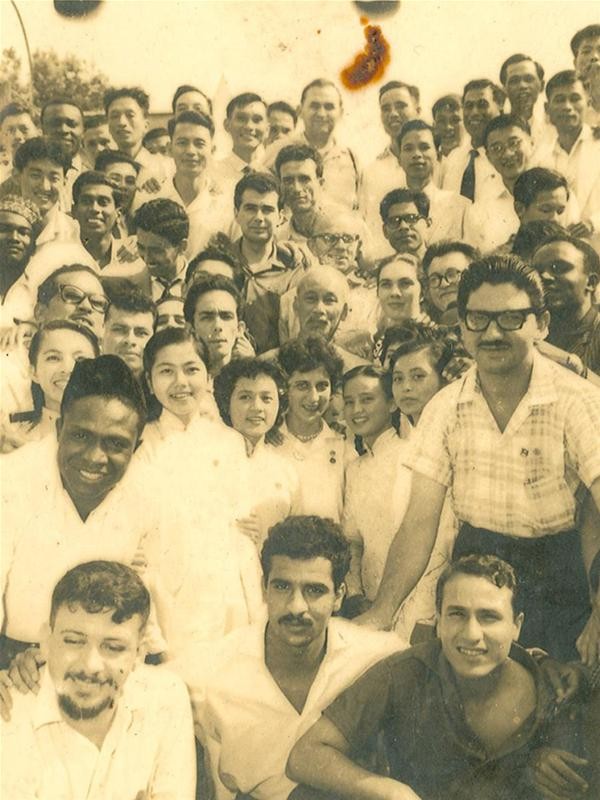
President Ho Chi Minh poses for a photograph with delegates attending the International Student Conference in Hanoi, September 1961
Over more than half a century of development, each generation of school and university students can take pride in the fact that, under all circumstances, Vietnamese school and university students, carefully nurtured by the Party and the State, have always carried forward and built upon the glorious traditions of preceding generations. For its particularly outstanding achievements in its work and contributions to building socialism and defending the Fatherland, the Vietnam Student Association has been honored with numerous distinguished awards over the past 74 years: the First-Class Independence Order for the first time in 2000; the Ho Chi Minh Order in 2005; the Gold Star Order in 2010; and the First-Class Independence Order for the second time in 2020.
Through their activities, school and university students contribute to educating and nurturing a new generation of students who are “both politically committed and professionally competent”; possess solid, extensive knowledge and the ability to access the intellectual advances of the age; are devoted to the ideals of national independence and socialism; have great aspirations and lead admirable lives; draw strength from tradition and national identity; and demonstrate a strong sense of responsibility toward the community. They also help strengthen and expand the Vietnam Student Association, bringing together and uniting large numbers of students to strive for excellence in their studies and personal development, contributing to industrialization and modernization and firmly defending the socialist Vietnamese Fatherland.
4. What Activities Mark Vietnamese Students’ Traditional Day?
Every year, the Vietnam Student Association launches student movements and organizes activities to mark Vietnamese Students’ Traditional Day.
Meaningful movements and programs include “Studying and training for future careers,” “Caring for students’ lives, rights, and obligations,” and “Cultural and sports activities and social work,” among others. These activities are regarded as a new step in the Association’s development, continually enhancing the quality of Vietnamese school and university students.
Other notable social activities at universities and colleges include “Repaying kindness,” “When drinking water, remember its source,” “Summer cultural enlightenment,” and “Humanitarian blood donation,” among others.
In particular, major campaigns such as “Green Summer,” “Volunteer Spring,” and the “Five-Good Student Movement” have attracted millions of registrations from young people, helping build a positive image of students in Vietnam.
Source: Collected materials
This is an automated translation. If you notice any errors, please contact the Department of Communications, National Economics University at phongtruyenthong@neu.edu.vn.