Kinhte.congthuong.vn: Assoc. Prof. Dr. Nguyen Thuong Lang: A Strategic Breakthrough in the Development Model for Vietnam’s Rice Industry
22/01/2024 2024-01-22 16:58Kinhte.congthuong.vn: Assoc. Prof. Dr. Nguyen Thuong Lang: A Strategic Breakthrough in the Development Model for Vietnam’s Rice Industry
Kinhte.congthuong.vn: Assoc. Prof. Dr. Nguyen Thuong Lang: A Strategic Breakthrough in the Development Model for Vietnam’s Rice Industry
The achievements accumulated by Vietnam’s rice industry affirm that now is the time for a strategic breakthrough toward an industrialized development model.
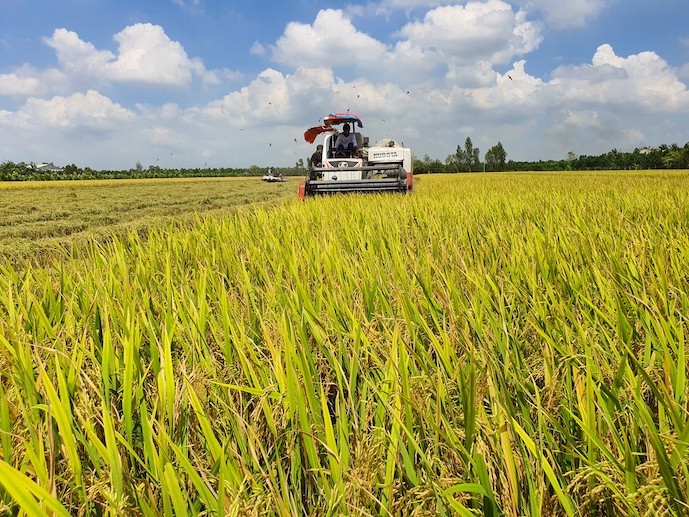 |
| Illustrative image. |
This is the view of economist Assoc. Prof. Dr. Nguyen Thuong Lang of National Economics University (NEU) on the new missions for Vietnam’s rice industry.
Why do you believe now is the right time for strategic breakthroughs in the development model for Vietnam’s rice industry?
During 1988-2023, Vietnam accumulated extensive experience in developing this industry, enabling it to make remarkable progress. Vietnam set new records in its development, including winning the world’s best rice title twice and achieving its highest-ever export revenue. Vietnamese rice prices also surpassed those of Thailand, a global powerhouse in rice exports for decades.
These achievements demonstrate the rise of Vietnam’s rice industry and mark its entry into a new stage of development. This requires upgrading the rice industry to a new level and, at a higher level, making a strategic breakthrough in its development model to meet new development standards and conditions, supply rice on a large scale, fulfill a higher mission, and adopt a new industrialization model guided throughout by agricultural economic thinking.
 |
| Expert Nguyen Thuong Lang |
Could you elaborate?
Over 36 years (1988-2023) of continuous achievements, Vietnam’s rice industry has built substantial, solid internal strength, establishing an unprecedented position for the industry. This is reflected in its extensive and particularly valuable experience in industry development through various models. Vietnam also has experience in extensive cultivation, monoculture, and intensive cultivation in the rice industry, and has established an industry network.
Vietnam has maintained stable rice export volumes after ensuring rice reserves meet regulations and sufficient rice is available for domestic demand. Exports of approximately 7-8 million metric tons per year demonstrate a stable supply and an established supply chain, with no instability in supply arrangements, particularly regarding land allocated to rice cultivation, the workforce, and investment capital. Foreign partners’ demand for Vietnamese rice imports remains stable and even tends to increase when adverse natural conditions reduce global supply.
This demonstrates market stability, appropriate average profits, equitable sharing among stakeholders, suitable regulatory policies, and favorable climatic conditions. As a result, foreign partners’ confidence in Vietnam’s rice supply chain has increased.
Notably, Vietnamese rice prices have reached the highest level in the world. In the fiercely and continuously competitive global market economy, buyers or customers play the decisive role, rice export profits are equalized, and there is absolutely no state intervention. Thus, the highest rice prices reflect the highest rice quality. This provides a basis for assessing improvements in the Vietnamese rice brand, while consumers worldwide are becoming increasingly familiar with Vietnamese rice. Its reputation for excellent taste is spreading globally, offering the potential to achieve economies of scale worldwide.
Consecutive years of good harvests have enabled Vietnam’s rice industry to accumulate large-scale supplies, allowing it to provide substantial quantities of rice to offset sudden supply shortages from other countries. Vietnam has become a major rice supplier, contributing significantly to stabilizing rice prices and thereby preventing global rice prices from rising too high. This is an important force helping the world avoid a global food crisis.
A new institutional framework directly supporting rice industry development has emerged through the Project for Developing One Million Hectares of High-Quality, Low-Emission Specialized Rice Cultivation Linked to Green Growth in the Mekong Delta by 2030. The direction and methods for developing the rice industry have been defined in concrete terms. The project provides an important foundation for strengthening the rice industry’s internal capacity.
Could you clarify what the new mission of Vietnam’s rice industry entails?
Vietnam’s commitment to being a responsible member of the international community is affirmed in its policy of proactive and active international integration. This is a steadfast, comprehensive, progressive, and long-term commitment. From the rice industry’s perspective, this responsibility needs to be elevated into a new mission for the industry. Vietnam’s strengths are combining effectively with development opportunities, creating momentum for the industry to overcome its weaknesses and considerable challenges in the new stage of development.
 |
With its significantly enhanced position in the global market, Vietnam’s rice industry needs to proactively and actively change or refresh its vision, elevating its basic responsibility to the international community into a historic, transformative mission within the global rice industry. It can positively influence global food security and shift consumption patterns from medium- or upper-medium-quality rice toward high-quality, organic, and good-tasting rice. This is a mission to transform the welfare of rice consumers worldwide.
The rice industry needs to draw on international resources and international partners’ support in finance, technology, and highly skilled personnel. It also needs to prioritize cooperation with international partners to increase interaction and acquire further knowledge, information, and new experience for development.
What, then, are the requirements of this new mission for Vietnam’s rice industry?
Vietnam’s rice industry is clearly preparing to cross a new development threshold. Its development outlook is more optimistic, with a nobler and greater mission than a responsibility focused primarily on meeting minimum obligations, while its strengths are considerable and its development opportunities are virtually boundless.
This requires a strategic breakthrough in the development model: a rice industry model organized on an industrial scale, with industrial operating methods and connections. The industry’s product and service value chains are merely constituent elements. This model must be viewed as a development ecosystem with a full digital foundation, leading rice research and development, advanced research, laboratory, and testing facilities, sophisticated technology, and a workforce of the world’s leading rice specialists. The rice produced must meet the most demanding needs and even shape demand through technological breakthroughs. Production and processing must reach advanced global standards. Rice production processes must be scientific. Warehousing, transportation, and forward and reverse logistics systems must meet standards for digital transformation, green transformation, energy transition, and low net emissions.
Leading technological advances in this field contribute to appropriate storage and preservation, maintaining consistent quality. A professional marketing system must develop effective rice branding techniques to establish Vietnamese rice as the world’s number one. Online trading systems must be developed, particularly a Vietnamese rice exchange based in Vietnam that serves as a hub for the ASEAN region. Investment is therefore needed to establish and develop a Rice Exchange or a Vietnamese Premium Rice Exchange connected to exchanges in major centers. The Vietnamese rice exchange needs to become a central exchange linking rice sources from India, Thailand, Cambodia, Myanmar, and other suppliers to become the world’s rice exchange. The rice industry workforce must receive systematic, specialized training and development and be able to use various types of equipment and digital technologies effectively.
A thorough analysis shows that Vietnam already has almost all the conditions needed to achieve this strategic breakthrough in its development model. Furthermore, this strategic breakthrough falls within Vietnam’s three strategic development breakthroughs proposed and implemented since 2011. Therefore, successfully achieving this strategic breakthrough in the development model will contribute to successfully realizing the three national strategic breakthroughs that have been affirmed and steadfastly pursued.
– Thank you!
This is an automated translation. If you notice any errors, please contact the Department of Communications, National Economics University at phongtruyenthong@neu.edu.vn.