
Vneconomy.vn: Addressing Medium- and Long-Term Funding for the Real Estate Market. Prof. Dr. Pham Hong Chuong – Prof. Dr. Hoang Van Cuong
10/10/2024 2024-10-10 16:24Vneconomy.vn: Addressing Medium- and Long-Term Funding for the Real Estate Market. Prof. Dr. Pham Hong Chuong – Prof. Dr. Hoang Van Cuong
Vneconomy.vn: Addressing Medium- and Long-Term Funding for the Real Estate Market. Prof. Dr. Pham Hong Chuong – Prof. Dr. Hoang Van Cuong
The Real Estate Market
Faces Not Only a Shortage of Medium- and Long-Term Capital but Also Imbalances
Between Supply and Demand and Across Segments; Experts at a Conference This Morning
(October 10, 2024) Proposed Solutions to These Problems…

On October 10, 2024, National Economics
University (NEU), in collaboration with the Ministry of Natural Resources and Environment and the Ministry of Construction,
organized a national scientific conference titled “Vietnam’s Real Estate Market in the Context of Amendments to the Land Law, Housing Law, and Law on Real Estate Business.”
Instability Caused by Supply Shortages
Speaking at the conference, Prof. Dr. Pham Hong
Chuong, President of NEU, said that in
2022-2023, Vietnam’s real estate market faced numerous difficulties and
challenges, partly attributable to legal obstacles. However,
from 2024 onward, the real estate market was expected to see positive changes
as the important laws mentioned above were implemented.
Previously, in November 2023, the National Assembly
voted to pass the 2023 Law on Real Estate Business (amended)
and the 2023 Housing Law (amended). In early 2024, the most eagerly anticipated Land Law (amended)
was also passed.
“When a tax mechanism targeting speculation
is implemented, only real estate for use will be encouraged: people will buy homes
to live in or rent homes to live in, rather than buy houses and land to accumulate assets as they do now,”
Cuong emphasized.
Prof. Dr. Hoang Van Cuong, Member of the National Assembly’s Finance and Budget Committee
The three laws mentioned above took effect on August 1,
five months earlier than previously decided by the National Assembly, helping complete
the final pieces of the legal framework for the real estate
market.
“The real estate market has grounds to
expect a more sustainable recovery as an important legal framework
takes shape, with numerous regulations and policy mechanisms affecting
the market and its participants,” Chuong emphasized. Although
the Government has provided intensive direction and management, many bottlenecks remain
unresolved following the entry into force of the new legal documents.
At the conference, delegates and experts
clarified how changes to the legal framework and new policy mechanisms
would affect Vietnam’s real estate market in the coming period as the important laws
take effect. They also proposed
specific, timely policy mechanisms to implement the Government’s major initiatives
for developing the real estate market, while supporting
research and the drafting and issuance of subordinate legislation (decrees and circulars)
by the Ministry of Natural Resources and Environment and the Ministry of Construction.
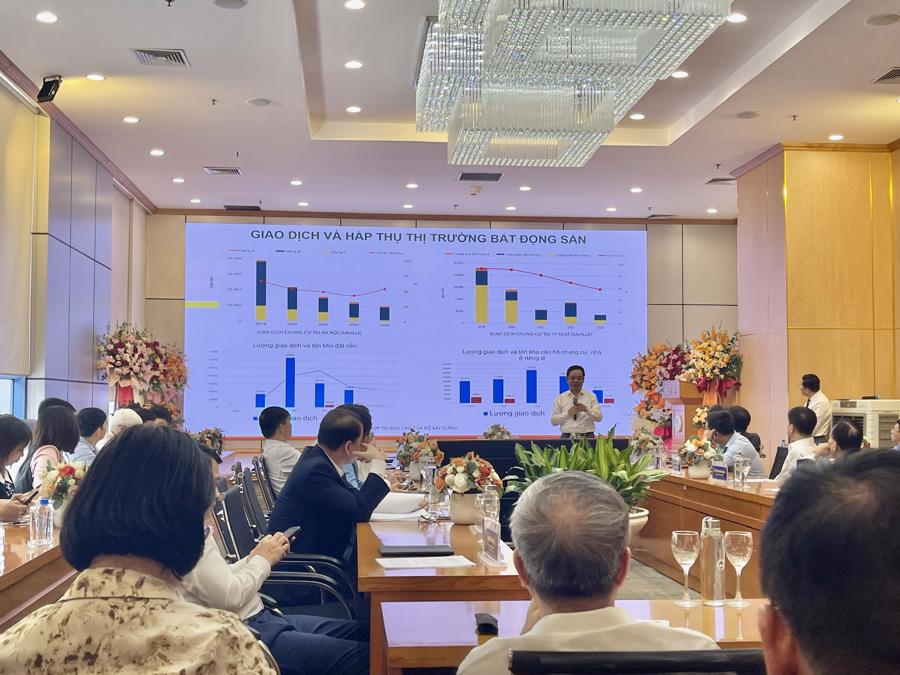
Discussing changes in the real estate
market and forecasting developments in the coming period, Prof. Dr. Hoang
Van Cuong, Member of the National Assembly’s Finance and Budget Committee and senior lecturer
at NEU, pointed out that the number of apartment
and social housing projects, as well as new properties launched recently, was very modest.
This could lead to a housing supply shortage in the
coming period. “The market currently has supply-demand imbalances in certain
segments,” Cuong observed.
With a limited supply of properties on
the market and strong demand, prices in Hanoi tend to rise rapidly. Meanwhile,
in southern provinces, including Ho Chi Minh City, during
2023-3024, demand showed virtually no growth and prices across segments did not increase,
except for apartments, which maintained growth of approximately 6%.
Speaking at the conference, Vuong Duy
Dung, Deputy Director of the Housing and Real Estate Market Management Agency (Ministry of
Construction), said that real estate prices had fluctuated locally in certain real estate segments
and in certain provinces and cities. In Hanoi in particular, some real estate
projects and land auctions recorded prices far above starting prices and
general market levels. This calls for clarification of what is driving real estate price increases
and whether they stem from newly issued policy mechanisms.
Where Can Medium- and Long-Term Capital Be Found?
Forecasting growth scenarios for the real estate
market in the coming period, Prof. Dr. Hoang Van Cuong highlighted several factors,
including economic growth and rapid urbanization, which are expected to drive continued growth in real estate demand.
Real estate is concentrated in many major cities,
where demand is strong. The anticipated acceleration of urbanization
will naturally increase demand.
Regarding the environment enabling the development
of the real estate market, Cuong expressed hope that the many newly enacted laws
and the new legal framework would resolve the procedural bottlenecks experienced recently.
Furthermore, provinces and cities have in recent years
focused intensively on developing local and urban plans, thereby
creating new space for development.
Proposing measures to establish balance in
the real estate market, Nguyen Van Dinh, Chairman of the Vietnam Association of Realtors
(VARS), said that policies regulating the real estate market in the coming period
should provide greater support for the affordable segment,
enabling substantive and stable market development.
Pointing out the imbalances in the development
of housing segments in the market, Dinh said that the market
was dominated by high-end properties for wealthy buyers and speculators, while the
Government was also vigorously promoting the social housing segment. However, the
affordable segment faces shortages, with no new projects in sight. This is the
segment with the greatest demand, yet supply is lacking—an abnormal situation.
“Market instability
and recent price increases stem from very weak supply and strong demand. When supply improves
and increases, it will help balance the market and bring prices under more reasonable control.”
Nguyen Van Dinh, Chairman of VARS
According to Dinh, market regulation should
increase supply wherever it is lacking and expand any segment facing a shortage
of properties. Implementation of the new legal framework and dissemination of the new
regulations also need to accelerate.
Alongside removing legal obstacles, how
to address funding needs to help resolve instability
in the real estate market was another issue that drew the experts’
attention.
According to Prof. Dr. Hoang Van Cuong, reducing
short-term lending interest rates will not increase real estate supply. Instead,
an interest-rate package for long-term real estate loans would generate
new demand and bring balance to the market.
However, according to Cuong, commercial
banks face difficulties financing real estate projects that typically last
5-10 years. Instead, to unlock capital mobilization for the real estate
market, potential sources include the Vietnam Bank for Social Policies, real estate
bonds, and buyers’ advance payments. In addition, trust funds open up a more flexible
fundraising market, allowing investment in real estate projects that are still
at the concept stage, with small sums of only VND a few million.
“Legal bottlenecks need to be resolved so that barriers
are removed, investors can invest more easily, and costs are reduced to improve
access to real estate supply,” Cuong noted. However, care must be taken
to avoid developing projects en masse only to leave them abandoned, resulting in inefficient investment of society’s resources,
as in 2026-2017. Instead, investment must follow housing development
plans and meet people’s needs, rather than allowing indiscriminate investment
wherever developers wish to invest.
The representative of the National Assembly’s Finance and
Budget Committee also highlighted new developments in modern urban
models, known as TOD cities and 15-minute cities, with high population
concentrations and integrated services, based on the development of urban railway systems.
Emphasizing new changes in the real estate
market as several important laws have just taken effect, Cuong
argued that when land prices track market prices, the absence of measures
to curb speculation will push property prices to a new level that will be difficult
to bring down. One solution under discussion is to explore ways to tax speculation
to reduce real estate prices.
Anh Tuyet
Link: https://vneconomy.vn/giai-bai-toan-nguon-von-trung-dai-han-cho-thi-truong-bat-dong-san.htm
This is an automated translation. If you notice any errors, please contact the Department of Communications, National Economics University at phongtruyenthong@neu.edu.vn.



