
Tienphong.vn: Prof. Dr. Hoang Van Cuong: The Real Estate Market Is Out of Balance
13/10/2024 2024-10-13 8:26Tienphong.vn: Prof. Dr. Hoang Van Cuong: The Real Estate Market Is Out of Balance
Tienphong.vn: Prof. Dr. Hoang Van Cuong: The Real Estate Market Is Out of Balance
South is stable, with property prices almost unchanged. In Hanoi, prices across market
segments are tending to rise rapidly. “The market is currently out of
balance,” Prof. Dr. Hoang Van Cuong observed.
Speaking at a seminar on the real estate market to clarify changes, developments, and market forecasts, Prof. Dr. Hoang Van Cuong,
a member of the National Assembly’s Finance and Budget Committee and a senior lecturer at
National Economics University (NEU), pointed out that the number of apartment and social housing
projects and new properties launched recently has been very modest. The
market currently faces supply-demand imbalances in some segments.
The
real estate market in the South is stable, with property prices almost
unchanged. In Hanoi, prices across market segments are tending to rise rapidly. “The market is currently
out of balance,” Cuong observed. The properties
traded recently came from projects on which construction had started
earlier, while the number of new project starts has been very low. Supply has therefore
increased, but has not reached the level required for a balanced market.
This has established a new price level in the real estate market.
Developing Modern Urban Models
Forecasting
growth scenarios for the real estate market in the coming period, Prof. Dr.
Hoang Van Cuong highlighted several factors, including the pace of economic
growth and rapid urbanization, which are expected to drive continued growth in real estate demand.
This is because real estate is concentrated in many major cities, where demand is strong. The
projected acceleration of urbanization will naturally increase demand.
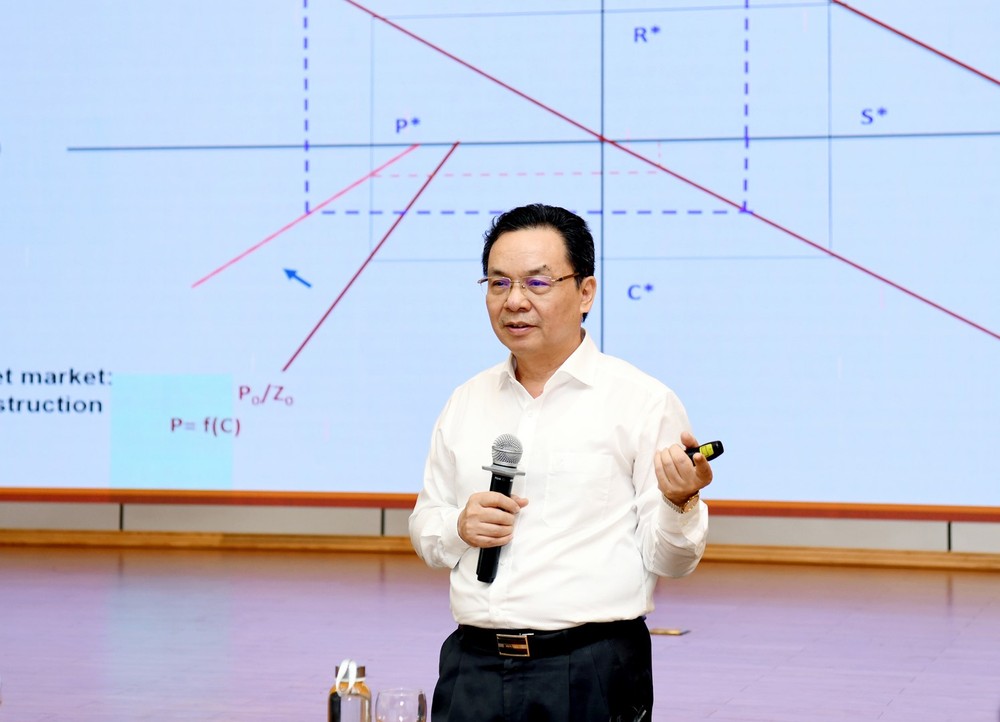 |
Prof. Dr. Hoang Van Cuong – National Assembly deputy, former Vice President of NEU. |
Regarding an environment conducive to the development of the real estate market,
Cuong expressed hope that three newly enacted laws and the new legal framework would
clear the procedural bottlenecks experienced recently and support
professional real estate investors with substantial resources in meeting
market demand and gaining access to real estate projects.
Furthermore,
room for real estate development is also opening up. In recent years, provinces
and cities have focused intensively on developing local
and urban plans. Once barriers to access to land
and projects are removed, supply will become more abundant and
meet the economy’s growth needs in the coming period.
“When
the economy grows, real estate will develop strongly. This has
been demonstrated throughout market cycles. With expectations for GDP
growth during 2025-2030, we can be confident
that the real estate market will continue to grow,” Cuong commented.
At
the seminar, Prof. Dr. Hoang Van Cuong also offered recommendations for
stable economic and real estate market development, including credit
policies to increase capital, expanding real estate supply, and developing modern
urban models, among others.
According to Prof. Dr. Hoang Van
Cuong, credit controls help limit real estate investment.
This tool can therefore be used for short-term regulation, but using it
over the long term will create market imbalances.
Reducing
short-term lending rates will only affect real estate
inventory; without new supply, market balance cannot be maintained.
Instead, interest rate support for long-term
real estate loans is what creates new demand and balance in the
market. Cuong said that this long-term credit can only
come from the Vietnam Bank for Social Policies, real estate bonds, buyers’ advance payments, or investment trusts.
At
the same time, legal bottlenecks must be removed and access expanded so that more
projects can begin construction to increase supply. However, this must follow housing development
plans that meet demand, rather than allowing development wherever investors wish,
resulting in the indiscriminate investment seen in the past.
In
addition, modern urban models should be developed, including TOD urban areas, also
known as 15-minute cities, with high population density and integrated services meeting
all amenity needs. The development of low-rise housing on subdivided lots should be limited.
Taxation to Curb Speculation Must Be Timed Carefully
Alongside
these measures, mechanisms to prevent speculation must be considered. According to
Cuong, without controls on speculation, the market will establish ever more
new price levels, making land valuation more difficult and directly
affecting land users’ interests, resulting in unsustainable
market development.
Taxation will reduce
real estate prices and have a long-term effect, benefiting consumers.
However, its introduction must be timed carefully.
With
a taxation mechanism in place, only real estate purchased for use would be encouraged, such as
purchases for owner occupancy or rental. This would promote the development of an affordable housing
market rather than purchases for asset accumulation, as is currently the case.
Duy Minh
Link: https://tienphong.vn/gsts-hoang-van-cuong-thi-truong-bat-dong-san-dang-mat-can-bang-post1681302.tpo
This is an automated translation. If you notice any errors, please contact the Department of Communications, National Economics University at phongtruyenthong@neu.edu.vn.